

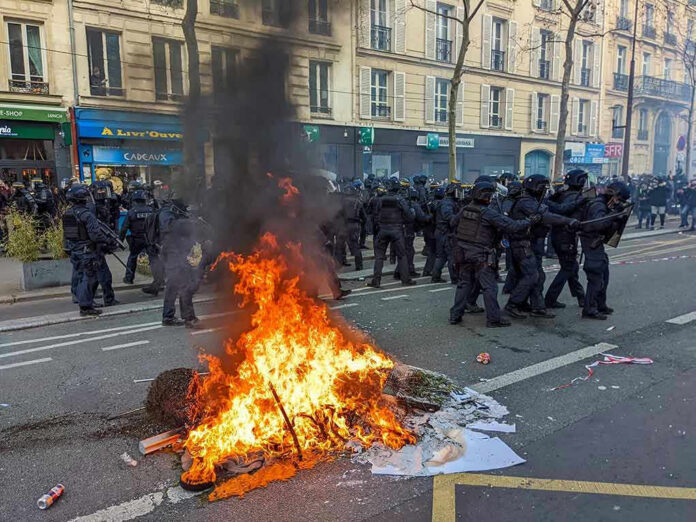
France’s third straight weekend of demonstrations in Paris hardened into a classic French public-order operation: large, mobile crowds; a visible riot-police presence; targeted curfews and protest bans after dark; and repeated clashes featuring tear gas and rapid-response units moving to protect key sites and businesses.
At a Glance
- Paris authorities deployed substantial police and gendarmerie forces citywide, concentrating around symbolic and commercial corridors.
- Specialized riot-control units, including CRS 8, executed agile, hotspot-driven interventions in areas like Les Halles.
- Curfews and geographically bounded protest restrictions were imposed to limit nighttime disorder around major gathering points.
- After violence outstripped initial expectations, the government expanded the deployment to 70,000 nationwide the following weekend.
What happened in Paris and why authorities surged forces
French authorities moved forcefully to shape the rhythm and geography of a turbulent protest cycle. In Paris, police staged a conspicuous presence near the Champs-Élysées and the Arc de Triomphe and used tear gas as confrontations flared. Similar clashes unfolded in other cities, accompanied by looting, vandalism, and attacks on public buildings and police, which officials cited as justification for a tougher posture. Within the capital, the prefecture directed a high-mobility strategy—anticipating fluid marches and fast-forming breakaway groups—anchored by the CRS (Compagnies Républicaines de Sécurité), France’s dedicated riot-control arm. CRS 8, a rapid-intervention riot unit, was tasked to Les Halles, where its mandate was to intervene quickly and repeatedly to restore calm as trouble spots emerged.
As the weekend progressed, police constrained nighttime assembly. The Paris prefecture barred protests in designated zones after 8 p.m., then imposed a curfew from 11 p.m. to 6 a.m. around Place de la République and Les Halles, measures backed by deployments positioned to enforce them. The legal logic was straightforward public-order prevention: if violence consolidates after dark, narrow the time-and-place window in which crowds can form and move.
The security operation’s scale and stated rationale
The government framed the weekend posture as order maintenance in the face of escalating disorder, not a show of force for its own sake. Interior Minister Laurent Nunez said police would be “uncompromising with rioters, looters and all those who commit acts of violence,” pairing that stance with an expanded security footprint for follow-on demonstrations. A week after the sharpest surge of violence, the Interior Ministry lifted the nationwide deployment to 70,000 officers and gendarmes—10,000 more than the prior weekend—explicitly acknowledging that authorities had underestimated the unrest on October 17 and needed greater mass to deter and suppress roving violence. That admission matters: it concedes operational shortfall in the initial response while underscoring the administration’s willingness to scale up.
The escalation problem was real. Reuters’ field reporting documented vandalism in Marseille, attacks on media and police, damage to public buildings, and recurrent clashes in the Paris basin—precisely the stimulus that drives French commanders toward cordon-and-intervention tactics, dispersal grenades, and targeted curfews. The tools are controversial but familiar within the French repertoire: distance-based crowd control, shield lines, tear gas, and specialized mobile units trained for running battles in dense urban terrain.
How France polices turbulence: doctrine, units, and the Paris fit
Paris’s weekend posture sits within a century-old French model of public-order policing that relies on permanent, professionalized formations. The CRS (established after World War II) and the Gendarmerie mobile (interwar roots) are built for this work: trained to hold lines, maneuver in platoon-size echelons, and redeploy quickly across an agitated city. Compared with many European peers, French equipment and crowd-dispersal methods skew more militarized—heavier protective gear, riot grenades, and large tear-gas inventories—reflecting both doctrine and France’s recurrent exposure to high-intensity street conflict. In practice, commanders toggle between containment (fixing processions on pre-agreed routes), separation (peeling away black blocs and agitator clusters), and denial (curfews, no-go perimeters) when opportunistic looting or arson appears likely.
That playbook is not new—and neither are the tensions it creates. France’s protest cycles often couple large peaceful marches with smaller cohorts that engage in vandalism or direct confrontation; police then calibrate force and mobility to handle the latter without crushing the former. The balance is difficult to sustain in tight cityscapes where a few dozen masked agitators can pivot a crowd dynamic in minutes.
What the numbers do—and don’t—tell us
On the evidentiary record available, several conclusions are firm. First, the Paris deployment was both large and deliberately structured around hotspots, with CRS 8 flagged publicly at Les Halles. Second, restrictions and curfews were time-and-place specific and explicitly enforced by deployed units. Third, the national footprint grew to 70,000 the following weekend after authorities judged their earlier posture insufficient to prevent widespread nighttime violence. Finally, the weekend involved real disorder—tear gas in central Paris, assaults on police and public buildings, and looting in multiple cities—undercutting any claim that commanders acted against a phantom threat.
What remains unresolved at this stage is narrower and technical rather than existential: we do not have a complete, Paris-only incident ledger tying each curfew or intervention to quantified reductions in assaults, injuries, or property damage. Nor do we have unit-by-unit deployment logs or a granular arrest breakdown distinguishing violent offenders from peaceful demonstrators and bystanders. Those records would sharpen assessments of proportionality and effectiveness, but their absence does not blunt the core facts of deployment, restrictions, and the disorder that prompted them.
A protest in Paris took a terrifying turn on October 31. 🇫🇷
During clashes near Porte de Charenton, Molotov cocktails were thrown at police officers, setting some of their protective gear on fire.
French authorities confirmed five officers were injured, including three who… pic.twitter.com/UWLhIxTAeP
— Kimmes (@kimmesspl) November 2, 2026
Why this pattern recurs—history and base rate
France’s recurrence of contentious protest followed by muscular policing is structural, not episodic. Specialized units exist precisely because the country has long experience with confrontational street politics—from May 1968 through the Yellow Vests to pension battles—where peaceful mass mobilization and violent fringe action frequently overlap in time and space. French doctrine emphasizes controlling distance and tempo; when marches splinter or turn fast and violent, commanders respond with mobility, gas, and perimeter control to re-impose sequencing on crowds that aim to outmaneuver fixed lines. That logic is on full display in Paris: agile deployments to commercial nodes, after-dark movement constraints at symbolic squares, and rapid intervention when opportunistic violence spikes.
What it means going forward
Operationally, the authorities signaled two takeaways. One, hotspot agility will define Paris deployments when processions are unpredictable; CRS 8’s tasking is the template. Two, after-dark curbs will recur when violence concentrates at night; narrow, enforceable geographic orders are now standard procedure. Politically, the Interior Ministry’s admission that it underestimated the first weekend’s unrest sets the expectation that subsequent weekends will open with heavier baselines and quicker escalations in response to any early vandalism or attacks.
The strategic test is twofold. Effectiveness is measured in prevented injuries and damage as much as cleared streets; proportionality is measured in the precision of enforcement—steering force toward violent actors without blurring into generalized repression. The weekend in Paris shows the state leaning on the tools it knows: mass, mobility, and managed nighttime space. Given France’s history and protest repertoire, there is little mystery why.