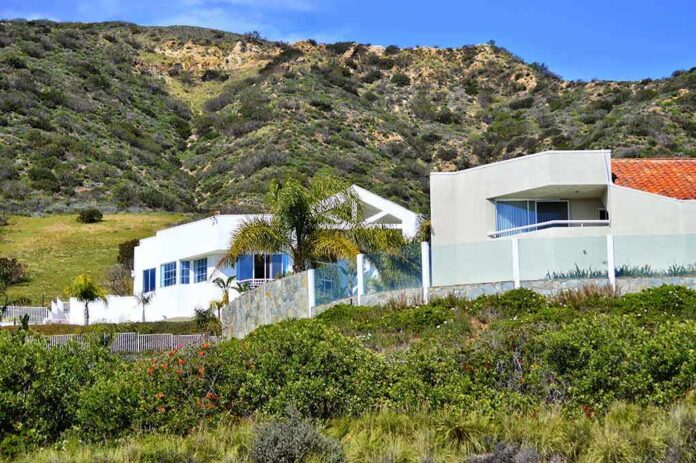
Million-dollar homes in a ritzy Los Angeles suburb are sliding toward the Pacific Ocean at rates once measured at nearly a foot a week, and taxpayers are now footing a growing bill to slow it down.
Story Snapshot
- Governor Gavin Newsom declared a state of emergency in Rancho Palos Verdes in September 2024 as land movement accelerated.
- Southern California Edison cut power and gas to hundreds of homes over fears that broken lines could spark fires or explosions.
- The city now spends roughly $53,000 a month running generators for wells that pump groundwater out of the hillside.
- Recent data show movement has slowed sharply, though the underlying landslide complex remains active.
Emergency Declared as Hillside Accelerates
Rancho Palos Verdes sits on a stretch of coastline known as the Greater Portuguese Landslide Complex. Land there has crept toward the sea for decades. But after brutal storms in 2023 and 2024, that creep turned into a sprint, with Newsom’s emergency proclamation stating that movement had “significantly accelerated” and reached as much as 9 to 12 inches per week.
Newsom signed the emergency order on September 3, 2024, citing disrupted utility services and evacuations tied to the shifting ground. The declaration freed up state resources to help the city respond, but it did not stop the hillside from moving. Officials said the area sits on four of five known sub-slides within the larger complex, a detail that shows just how unstable the ground had become.
Power and Gas Cut to Hundreds of Homes
Southern California Edison shut off electricity to protect residents from broken power lines twisting under the pressure of moving earth. The Los Angeles Times reported the utility cut power to more than 200 homes across two neighborhoods, Portuguese Bend and Seaview, as the ground gave way beneath them. Separately, the gas company cut service to 245 residences after pipes began cracking under the strain, leaving families without basic utilities through no fault of their own.
City records show the Portuguese Bend shutoff alone affected 193 customers, split between homes and small businesses. For residents who pay steep property taxes in one of California’s most desirable zip codes, losing power and gas service is a stark reminder that even wealth cannot buy stable ground. It also raises hard questions about how the state manages infrastructure in known hazard zones.
Taxpayers Cover the Cost of Standing Still
Fixing a moving hillside is not cheap, and local government is picking up much of the tab. Rancho Palos Verdes now spends about $53,000 every month just to rent and fuel generators that run deep wells designed to pull groundwater out from under the landslide. Those wells have removed more than half a billion gallons of water since the fall of 2024, enough to cover 58 football fields in ten feet of water.
Test boreholes drilled in 2024 revealed the landslide plane runs far deeper than city geologists first believed, according to Rancho Palos Verdes officials. That discovery means the fix will likely take longer and cost more than originally planned, a pattern familiar to anyone who has watched California infrastructure projects balloon in price while timelines stretch on for years.
Movement Slows, But the Danger Has Not Disappeared
There is some encouraging news. The city’s own survey data from early August showed the average movement rate inside the active landslide boundary had dropped to just under one inch per week, a nearly 10 percent decrease from the previous month. Edison has said sustained reductions in ground movement could eventually allow power to be restored to affected homes, giving residents a real incentive to watch the numbers closely.
Federal scientists note that Southern California’s hillsides are especially prone to this kind of slippage, particularly after heavy or prolonged rainfall, and conditions can worsen during El Nino years. The slowdown is real, but so is the underlying instability. Rancho Palos Verdes remains a case study in how fast nature can outpace even the wealthiest community’s ability to hold the ground in place, and how quickly taxpayer dollars get spent trying to buy time against it.
Sources:
nypost.com, rpvca.gov, laist.com, latimes.com, abcnews.com, documents.rpvca.gov, pubs.usgs.gov