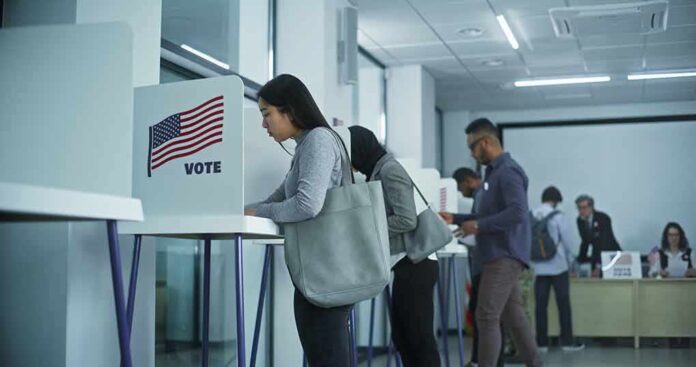
When ballot scanners fail, confidence wobbles before facts arrive; the discipline that preserves elections is the boring, paper-and-procedure layer that keeps a technical outage from becoming a legitimacy crisis.
At a Glance
- New York officials attributed the Westchester County scanner failures to a late programming change not deployed to all machines, causing ballots to be rejected rather than miscounted.
- Rejected ballots were secured under established emergency-ballot procedures and later counted through the normal canvass, recanvass, and audit process, according to state guidance.
- Rep. Mike Lawler urged voters to stay and cast ballots—he did not claim vote alteration—and officials prioritized restoring at least one functioning scanner per site with updated media.
- Speculative fraud claims surfaced without evidence, while experts underscored that pre-election testing should catch ballot-design or configuration conflicts.
What actually failed—and why rejection is safer than mis-tabulation
The core technical story in Westchester is specific, prosaic, and—importantly—contained: a late programming change tied to a single municipal contest was not propagated to all Election Day scanners. Machines that retained the earlier configuration could not recognize the new ballot definition and, by design, refused to accept the paper rather than guess how to interpret it. That failure mode matters. A scanner that rejects an unrecognized ballot creates inconvenience and backlog; a scanner that accepts and misreads the same ballot would silently corrupt the tally. State officials were explicit on this point: affected scanners rejected, they did not mis-tabulate.
This pattern aligns with how optical-scan systems operate. A ballot definition—effectively the scanner’s map of contests, positions, and mark thresholds—must match the printed ballot style. When a jurisdiction issues a late change for one race, administrators must regenerate “election media” (the removable cards or sticks with definition files), verify cryptographic hashes where applicable, and redeploy to every device that will see that ballot style. If any site runs the old media, the scanner cannot reconcile its internal map with the printed targets. The system’s conservative, fail-closed behavior is precisely what you want in a high-integrity environment: stop, don’t guess, hand the problem to humans with paper to review.
Continuity of voting: the emergency-ballot lane did its job
When scanners go down, voting should not. New York’s fallback is straightforward: voters still check in, mark a paper ballot, and place it in a sealed emergency container—typically the orange bags that became a visual shorthand on Westchester’s Election Day—until central or restored precinct scanners process them. State and county officials instructed poll workers accordingly and affirmed that these ballots move through the same canvass, recanvass, and post-election audit safeguards that apply to every other vote.
That design is not an improvisation; it is the point of a paper-centric system. After 2016, states accelerated the shift to auditable paper. By 2026, roughly all in-precinct voting produces a paper record that can be recounted or audited against machine totals, with scanners acting as calculators rather than keepers of truth. The legal canvass—the formal, multi-day process where bipartisan boards reconcile poll books, provisional ballots, machine logs, and physical ballot counts—remains the authoritative tally, not the Election Night tape or a dashboard widget. That is why delays are tolerable in service of accuracy.
Lawler’s posture, and the difference between disruption and alteration
Rep. Mike Lawler’s public stance tracked the administrative account. While acknowledging uncertainty about whether the issue was the ballot or the machine, he told voters to remain on site and cast their ballots while technicians and election officials worked the problem. His position was continuity-of-process, not claim-of-alteration. Meanwhile, Westchester officials prioritized getting updated election media to the field and restoring at least one working scanner at every location—an operational fix consistent with a configuration mismatch rather than a wholesale equipment failure.
This distinction matters in the current climate: a visible outage is disruptive, but disruption is not evidence of vote manipulation. The scanners’ reject behavior, the existence of emergency-ballot procedures, and the commitment to standard canvass and audit controls all align with an error that interrupts throughput, not one that changes marked voter intent in tabulation.
Where skepticism is fair: testing, documentation, and transparency gaps
Competent critics ask why pre-election testing—logic and accuracy checks using test decks for every ballot style—didn’t catch an incompatibility. They are right to demand that. Chris Krebs, who ran the U.S. government’s election security agency in 2018–2020, underscored that ballot stock or definition problems should surface before polls open. Here, the state traced the cause to a late programming change; that implicates change control and redeployment, not just initial testing. The professional questions are specific: who authorized the change, when were new definition files built, what hashes were recorded, which devices were updated, and where did acceptance tests occur?
The procedural side has parallel demands. Emergency-ballot use is legitimate only if chain-of-custody is tight: serialized seals, bipartisan signatures, transport manifests, receipt logs, and reconciliation between scanner reject counts and the physical inventory. Officials assured voters that every valid vote would be counted through canvass, recanvass, and audit; the credibility of that assurance increases when jurisdictions publish precinct-level reconciliation and audit reports that match the narrative. Those records close the loop the public cannot see on Election Day.
Why fraud claims fail here—and what history actually teaches
Social-media allegations leapt to motive—“cheating,” “steal the election”—without offering contrary facts about tabulation, chain of custody, or mismatched canvass totals. That is rhetoric, not evidence. In contrast, the specific, on-record account of a late programming change producing scanner rejections is consistent with known failure modes in optical-scan elections and with the state’s emphasis on paper-backed canvasses and audits.
Historical base rates also cut against leapfrogging to fraud. Reviews of election problems over the last two decades show that many real failures are administrative—ballot-definition errors, configuration mismatches, or equipment defects—and that rigorous canvass and audit procedures are designed to surface and correct them. Research from the Brennan Center documents both the reality of occasional machine and administrative errors and the rarity of actual voter fraud; modern systems mitigate the first with paper and process, and the second is statistically minuscule in well-run jurisdictions.
🚨 Westchester New York Ballot Scanners Fail COUNTYWIDE After Late “Programming Change” Linked to Ardsley Race
“People are not happy.. and it’s not sitting well with a lot of people— it is not common.”
Letitia James says her office is monitoring the situation.. lol pic.twitter.com/39CJ0AQvoP
— DJ CandyMan (@DrCandymn) November 4, 2026
The durable lessons for administrators and voters
Two truths can coexist: Westchester experienced a serious, countywide disruption; and the available evidence supports an administrative configuration failure buffered by paper-based safeguards, not altered vote totals. The durable lessons are practical. For administrators: tighten change management, insist that any late ballot or contest modification triggers a full redeploy-and-verify sequence, publish hashes of election media, and release post-election reconciliation and audit artifacts as a matter of course. For voters: insist on paper, be patient with canvass timelines, and evaluate claims by their specificity—mechanism, records, numbers—not their volume.
Sources:
pjmedia.com, lohud.com, abc7ny.com, thehill.com