

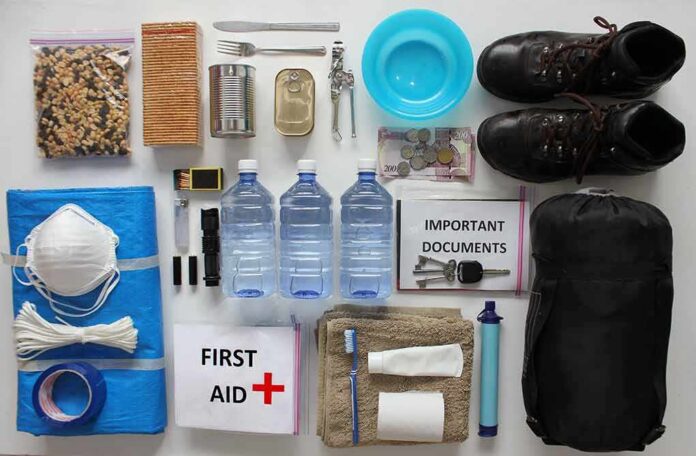
The most effective “survival trick” for a winter power cut is not exotic gear but deliberate heat conservation: trap the warmth you already have with layers, blankets, and a small, sealed living space — advice the UK’s official preparedness guidance has standardized for years, irrespective of whether a polar vortex disrupts the season.
At a Glance
- UK government-backed guidance explicitly recommends blankets, sleeping bags, and layered clothing to stay warm during power cuts.
- During an outage, close off unused rooms, draw curtains, and reduce heat exchange — basic physics that keeps you safer for longer.
- Polar-vortex disruptions can increase the odds of UK cold spells, but their surface impacts are probabilistic, not guaranteed.
- Warmth is one part of a full outage plan that also covers light, water, food, communication, and support for vulnerable people.
What the official guidance actually says about staying warm
When electricity or heating fails, homes cool quickly; the government-backed Be Ready campaign is explicit about countermeasures: keep warm using blankets, sleeping bags, and layered clothing. This is not a social-media hack; it is standard preparedness practice aimed at slowing the loss of body heat until services return or help arrives. The same guidance adds practical heat-retention steps for the building itself — close internal doors to unused rooms and draw curtains to reduce drafts and radiation to cold window surfaces — because heat moves along temperature gradients, and any reduction in air exchange buys time and comfort.
Public-health messaging aligns with this personal insulation strategy. UK advice for extreme weather recommends “several thin layers,” which collectively trap more insulating air than a single bulky garment, and calls out blankets, sleeping bags, or dry towels as tools for controlled rewarming. The point is not fashion; it is physiology. Layering manages moisture, limits convective heat loss, and reduces the rate at which core temperature drifts downward in a cold environment — particularly important for older adults or anyone with cardiovascular or respiratory disease.
Why these measures work: mechanisms of heat loss and retention
Outage survival is about managing conduction, convection, radiation, and evaporation. You cannot heat the whole house without power; you can, however, shrink the thermal problem to a small, sealed “warm room.” Close doors to confine warmed air, block draughts at the floor, and cluster people — shared metabolic heat matters. Clothing layers trap still air; a blanket over a person, or even over a cold appliance or surface, reduces heat exchange. The Met Office extends the same principle to food safety: keep fridge and freezer doors shut, and even drape a blanket over them to slow warming — a simple way to preserve cold mass for many hours during an outage.
Think in terms of gradients. Every thin barrier that slows air movement or adds trapped air increases thermal resistance. Curtains over windows, rugs on bare floors, a hat and gloves on otherwise warmly dressed people — each increment reduces the net heat flow from skin to room to outdoors. When these low-tech steps are stacked, the combined effect can be the difference between mild discomfort and dangerously cold indoor conditions.
Polar vortex, sudden stratospheric warming, and what it does — and doesn’t — predict
The “polar vortex” is a stratospheric band of westerly winds that, when strong, helps confine Arctic air. During sudden stratospheric warming (SSW), those winds weaken or reverse. The disrupted circulation can alter the jet stream, encouraging high-latitude blocking that funnels colder air into northern Europe, including the UK. The mechanism is real and well documented by the Met Office; some SSWs have preceded significant UK cold spells. But these linkages are statistical, not deterministic, and individual events are only reliably forecast on roughly weeklong horizons.
That uncertainty does not negate preparedness. It clarifies the frame: blankets and layers are endorsed because any winter outage can be hazardous, not because a specific stratospheric event guarantees blackouts. The correct takeaway is conditional readiness — households adopt low-cost measures that work across many plausible cold-weather scenarios, while meteorologists track SSW evolution and surface impacts in nearer-term windows.
Warmth is necessary, not sufficient: round out the household plan
Insulating yourself is step one; a safe plan covers essentials beyond warmth. Official outage preparedness calls for lighting (torches, spare batteries), non-perishable food that can be eaten cold, safe water, a way to receive updates (battery or wind-up radio), and phone charging. Support for vulnerable people — the very young, older adults, those less mobile, or anyone dependent on electricity for medical equipment — must be planned in advance, ideally via your energy provider’s Priority Services Register and local support networks.
Cold also creates secondary risks. Avoid dangerous improvised heating: never run fuel-burning devices indoors without proper ventilation and carbon monoxide alarms. Protect plumbing by keeping one “warm room” where pipes pass, opening sink cabinets on exterior walls, and knowing how to shut off the water if a pipe bursts. Food safety follows the “keep it closed” rule; a stocked pantry reduces how often you need to open a warming fridge. These are mundane tasks that prevent outsized damage during a long winter evening without power.
Who is most at risk, and how households can adapt
Cold stress is not evenly distributed. People who are unwell, less mobile, very young, or older are more susceptible to hypothermia and complications. Local-authority guidance mirrors national advice but adds a practical emphasis on checking neighbours and ensuring blankets, hats, and gloves are on hand for those who may struggle to self-manage layers. In multi-person homes, co-locating in a small interior room multiplies the benefits of clothing and blankets through shared body heat; for someone alone, a sleeping bag inside another bag or blanket stack can provide critical extra insulation.
If you or someone in your household relies on electrically powered medical equipment, preparedness is different in kind, not just degree. Coordinate with your clinician and energy supplier ahead of winter, confirm back-up arrangements, and ensure you have a non-electric communication fallback. The right plan is specific to the device, the person, and the likely outage duration — and should not be deferred to the first cold snap.
🚨 BREAKING NEWS: POLAR VORTEX VS. SUPER EL NIÑO — A WINTER WEATHER SHOWDOWN IS DEVELOPING!
🌎 NOVEMBER 12, 2026 — WINTER 2026–2027 OUTLOOK
Two powerful atmospheric influences could shape the coming winter, potentially producing dramatic temperature swings, powerful storms,… pic.twitter.com/Sa7pSmhp3G
— Adam Genesis 💒 🙏 ✝️ 🔥 Navigating the Last Days (@AdamGenesisEden) November 12, 2026
The grid picture: outages are possible, resilience is planned
It is reasonable to ask whether a colder spell implies higher outage risk. Britain’s system operators publish winter adequacy assessments, and in recent outlooks they have projected secure supplies with healthy margins in a typical cold season. Extreme weather still creates “tight days” and local network faults — for example, ice accretion or wind damage — so household preparedness remains prudent even when national adequacy looks strong. The public-health and preparedness guidance exists to bridge exactly this gap between system-level resilience and the lived reality of a downed local line on a freezing night.
That is the logic of blankets and layers: low-cost, immediate, and universally applicable. You do not need a bespoke forecast to justify them, and you should not wait for one. In winter, every household benefits from a warm-room plan, an accessible stack of blankets and hats, and the discipline to keep doors and curtains closed when the lights go out. Add light, water, food, and a way to call for help, and you have transformed a risky outage into a manageable inconvenience.
Sources:
mirror.co.uk, beready.campaign.gov.uk, weather.metoffice.gov.uk, centralbedfordshire.gov.uk, gov.uk, rbkc.gov.uk