
When gunfire erupts in a crowded venue, the first defender on scene often ends the threat before anyone else can arrive; that is exactly what happened inside Columbia’s Jamil Temple during a South Carolina Arms Collectors Association gun show, where a Lexington County deputy working security was shot and returned fire, killing the gunman.
At a Glance
- A Lexington County deputy providing security at the Jamil Temple gun show was shot by an attendee and returned fire, killing the shooter.
- The deputy underwent surgery and was reported in stable condition, a fact that independently confirms an armed exchange occurred.
- The deceased was identified as 34-year-old Telvin Pierre Portee; he died at the scene.
- Authorities reported no continuing public threat; South Carolina’s state investigative agency is leading the standard post-incident review.
What happened inside the Jamil Temple
According to the Lexington County Sheriff’s Department, a patron at the South Carolina Arms Collectors Association gun and knife show shot a uniformed deputy who was working event security. The deputy returned fire, striking and killing the attacker. The venue is a familiar site for weekend gun shows in the Columbia area, and the event’s rules bar loaded weapons for attendees; only on-duty law enforcement may be armed inside. Law enforcement on scene reported the situation contained quickly and emphasized there was no ongoing threat to the public once the shooter was down.
The deputy was transported for emergency surgery and, by the first evening updates, was described as stable—confirmation that a live-fire exchange, not a mistaken discharge alone, drove the encounter. The Lexington County coroner identified the deceased as Telvin Pierre Portee, 34, who died at the scene from a gunshot wound. Multiple outlets placed the incident specifically at the Jamil Temple during the South Carolina Arms Collectors Association show, anchoring the core sequence with consistent location and timing details drawn from county authorities and the coroner.
How deadly-force law evaluates an on-duty shooting like this
Officer-involved shootings are not judged by hindsight perfection but by what the “reasonable officer” could see and infer in the moment. Two U.S. Supreme Court decisions set the frame. In Graham v. Connor, the Court instructed that force must be assessed under the Fourth Amendment’s reasonableness standard, considering the severity of the suspected conduct, whether the subject poses an immediate threat, and whether he is actively resisting or attempting to flee. Tennessee v. Garner, decided earlier, held that deadly force may be used when an officer has probable cause to believe a suspect poses a significant threat of death or serious physical injury to the officer or others. If, as authorities reported, a customer fired at a deputy inside a crowded hall, the legal analysis aligns with a textbook “immediate threat” scenario.
The setting matters: a public event with tight aisles, dense foot traffic, and limited cover amplifies the risk calculus. A single armed assailant who has already fired a round represents an ongoing lethal threat until disarmed or incapacitated. In that context, a rapid counter-shot by on-site security is both functionally and legally what doctrine expects when time-to-neutralize is measured in seconds, not minutes.
Why the location and response are operationally significant
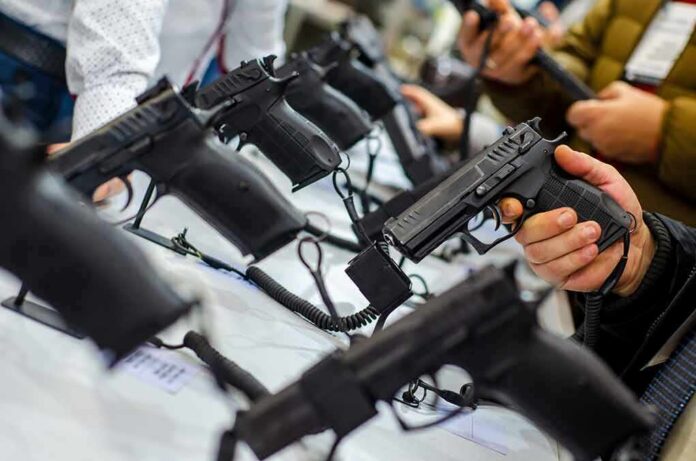
Gun shows impose strict handling protocols precisely to prevent negligent discharges: weapons are inspected at entry, magazines are cleared, and chamber flags or ties are commonly used. The South Carolina event followed the standard model—no loaded firearms for attendees, with the narrow exception for on-duty law enforcement. Those controls reduce accidental fire but cannot eliminate deliberate violence. When an assailant breaches the rules and fires, the fastest credible intervention comes from the sworn officers on site; in this case, the deputy’s counterfire terminated the incident before it became a mass-casualty event.
Authorities also moved quickly to stabilize the scene beyond the immediate shooting lane. Multiple neighboring agencies responded, cordoned the area, and ensured that attendees could exit safely once the threat was neutralized. The sheriff’s office publicly signaled the all-clear for broader community risk, an important threshold to prevent secondary panic or unnecessary lockdowns in nearby facilities.
What we know—and what the standard investigation will determine
The core facts are straightforward and uncontested in the public reporting: a deputy was shot by an attendee; the deputy returned fire; the attendee died; the deputy survived surgery in stable condition; and the venue was the Jamil Temple during a scheduled gun show. The Lexington County coroner named the deceased as Telvin Pierre Portee, 34. Specifics such as the number of rounds fired, distances, and the exact shot sequence typically come later from the lead investigative agency—in South Carolina, that is the South Carolina Law Enforcement Division (SLED)—which was requested to conduct the standard independent review following a deputy-involved shooting.
That review normally includes scene diagrams, recovered casings, autopsy and wound-path analysis, firearm function tests, and interviews. While those forensic details refine the timeline, they seldom change the central legal frame in a case where an officer has already been shot; under Graham and Garner, once a subject has proven both capability and intent to inflict deadly harm in a crowded public space, the law affords officers latitude to respond with decisive force to stop the threat.
Deputy kills man accused of shooting at him during gun show. Link in bio. pic.twitter.com/dvNUain0yx
— KWQC TV6 News (@kwqcnews) November 16, 2026
How this incident fits the broader pattern of police use of force
Nationally, fatal officer-involved shootings are assessed within a fragmented data landscape—no single authoritative federal dataset provides uniform detail across jurisdictions—so researchers rely on composite projects and public records. Even so, the jurisprudence is stable: courts ask what a reasonable officer would have done faced with an immediate lethal threat, not whether alternative tactics might be imagined after the fact. When a suspect fires on an officer in a public venue, the combination of immediate danger, proximity to bystanders, and the inability to safely disengage weighs heavily toward the reasonableness of prompt deadly force to neutralize the shooter.
The bottom line
In Columbia’s Jamil Temple, the danger began with a customer’s shot and ended when the on-duty deputy, already wounded, returned fire. The deputy survived. Telvin Pierre Portee did not. The public was not placed under extended threat, and the state’s investigative machinery is now doing the methodical work it exists to do. Under the governing legal standards, a uniformed officer who is fired upon in a crowded hall is permitted—indeed expected—to stop the shooter. The record to date supports exactly that sequence here.
Sources:
nypost.com, us.cnn.com, apnews.com, coasttv.com, panhandle.newschannelnebraska.com