
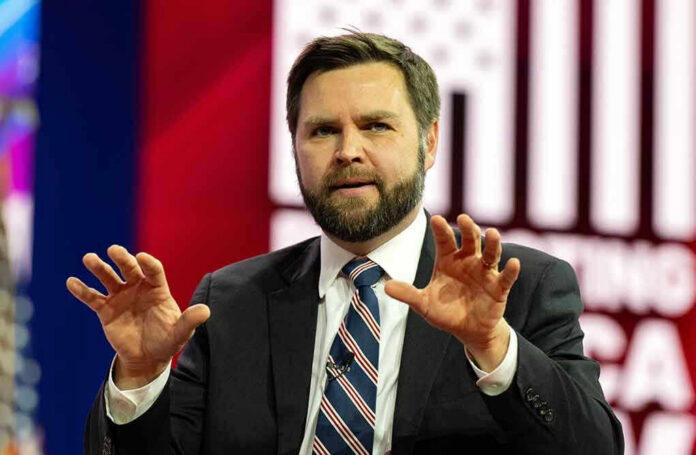
The clearest way to read J.D. Vance’s 2028 posture is as deliberate optionality: he is keeping the door open without walking through it, which is exactly how ambitious politicians preserve leverage, protect alliances, and avoid unnecessary fire while the landscape is still shifting.
At a Glance
- Vance has said plainly he has not decided whether to run in 2028; not running remains on the table.
- He frames any decision as downstream of current priorities and family considerations, not as a foregone conclusion.
- Speculation about a Trump endorsement exists, but Vance says they have not discussed 2028 directly and speaks conditionally about support.
- Strategically, this is classic succession positioning: maximize options now, decide when information is better and risk is lower.
What Vance Has Actually Said, and Why It Matters
Vance has twice, in high-visibility settings, emphasized that he has not made a 2028 decision and that declining to run remains possible. In a CBS News town hall, when pressed on whether there was any chance he would not run, he answered, “Of course there’s a chance,” while underscoring that his focus remained on near-term political work and family considerations. In a separate conversation aboard Air Force Two, he was similarly categorical about the lack of a decision—“I really have not made up my mind about what to do in 2028”—and, asked about President Trump’s potential blessing, he couched it in hypotheticals: if he runs, he thinks Trump would endorse him; they have not discussed it directly. Those answers are not accidental. They convey agency without commitment, and signal confidence without launching a campaign.
The significance is twofold. First, by articulating uncertainty himself, Vance blunts the sting of outsider speculation and keeps expectations within his control. Second, he preserves operational freedom with donors, activists, and allied officials who must plan for multiple futures. That is the essence of disciplined pre-candidacy behavior: communicate viability, not inevitability.
How Conditional Succession Positioning Works
Vice presidents and other party heavyweights almost always manage the gray zone between “prospective candidate” and “declared contender.” The incentives are straightforward. Early speculation enhances name recognition and convenes networks; a formal bid, by contrast, hardens opposition, triggers regulatory and press scrutiny, and locks in strategic choices too early. The modern toolkit includes media hits that test messages, donor retreats that map money, and policy forays that define lanes—all without crossing into the formalities of a run. When handled well, this shadow phase can function like a low-cost option: if conditions improve, you exercise it; if not, you let it expire with minimal reputational damage.
Polling fits awkwardly in this period. Early primary surveys can indicate who is known and broadly acceptable, but they are noisy predictors; their value increases as the calendar tightens and the field clarifies. A veteran strategist treats early numbers as a diagnostic—where the brand is soft, which coalitions are within reach—rather than as fate. Even the literature that credits early national primary polling with some predictive power does so with caveats about context and contest structure. In other words, early front-runner talk can be useful for fundraising memos, but it should not drive an irrevocable decision.
The Trump Question: Endorsement, Alignment, and Autonomy
Because President Trump remains the most powerful figure in Republican politics, any Vance pathway must account for presidential preference, even if tacit. Vance’s own language leaves this in the realm of informed inference rather than commitment: he has not discussed 2028 with Trump and frames endorsement as likely if—and only if—he runs. That formulation carries strategic benefits. It shows deference without presumption, it reassures Trump-world audiences that Vance sees himself inside the movement rather than above it, and it sidesteps the political liability of appearing to campaign while serving as vice president.
Endorsements can be decisive in crowded fields, especially when they unify activist networks and donor pipelines. But endorsements are also contingent; they rest on perceived electability, message fit, and timing. Treating a potential Trump nod as probable yet unbanked is the realistic posture for any would-be successor—confident enough to keep supporters engaged, modest enough to avoid a public contradiction that would undercut authority if Trump’s plans or preferences change.
Why Not Decide Now? Information, Timing, and Risk
Uncertainty is not a weakness here; it is strategic patience. The decision set Vance faces includes variables that are not yet knowable: how the party interprets the midterm cycle; what policy achievements or setbacks accumulate; whether other Republicans consolidate support or falter; where donor sentiment settles after a volatile period. Locking into a campaign too early would fix costs—time, money, and the opportunity cost of governing focus—before those variables resolve. Savvy actors wait for signal over noise.
Campaign law also encourages staged escalation. Potential candidates can “test the waters,” discreetly modeling finances and building infrastructure before triggering full reporting and other compliance demands. That framework rewards the kind of graduated engagement Vance is using: public openness, private scenario-planning, and decision only when the strategic and personal ledgers align.
Comparative Baselines: What History Suggests About Early Leads and Lanes
History is littered with early frontrunners who never reached the convention podium. The “front-runner fallacy” exists precisely because early advantages often reflect familiarity and media focus more than the durable coalitions that deliver delegates months later. Conversely, there are cycles—think an incumbent vice president following a popular administration—where early alignment and a narrow field do convert into nomination. The analytic point is not that early leads are meaningless; it’s that their meaning is conditional. They are a head start, not a finish line.
Scholarly work on polling accuracy reinforces that caution. General-election surveys months out are weak forecasters; primary polls, while somewhat more informative about who is plausible, sharpen meaningfully only as voters pay attention and the field winnows. Strategically, that argues for Vance’s current choice: cultivate viability and message discipline now, treat real entry as a late decision calibrated to the cycle’s facts rather than to today’s chatter.
Donald Trump suggested this week that he might not endorse J. D. Vance for president in 2028. @GrahamDavidA explores whether that would be good or bad news for Vance: https://t.co/ycgzFbybRp
— The Atlantic (@TheAtlantic) November 13, 2026
What to Watch Next
Three signals will indicate whether Vance converts optionality into a campaign. First, the staffing market: if seasoned operatives quietly align with Vance and defer other offers, that’s a tell. Second, the donor choreography: semi-public convenings that draw major bundlers suggest pre-commitment even if the event is billed as policy-focused. Third, message consolidation: when a would-be candidate’s rhetoric hardens into clear contrasts—on foreign policy, economics, or institutional reform—you are nearing the point of no return. None of those require a formal declaration to be legible to attentive observers; all three can unfold within the “testing the waters” framework until the calendar forces clarity.
Bottom Line
Take Vance at his word: he has not decided whether to run and sees non-entry as a live option. Read his behavior as the work of a disciplined politician managing succession dynamics—signaling strength, preserving alliances, and waiting for better information before turning speculation into a campaign. In American politics, that is not dithering; it is how serious contenders keep their powder dry until the fight is worth joining.
Sources:
mediaite.com, thehill.com, politico.com, washingtonexaminer.com, cbsnews.com, independent.co.uk, fox17.com, cjr.org