
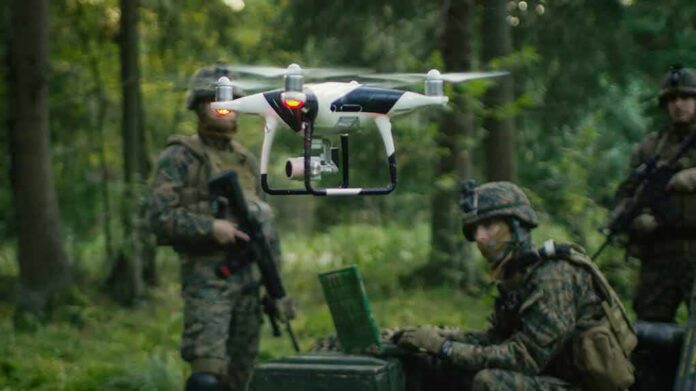
Ukraine’s drone war has reached a scale that is reshaping the battlefield, but it still has not replaced the hard rules of war.
Quick Take
- Analysts say drones now drive a huge share of battlefield losses in Ukraine.
- Ukraine has used drone strikes to hit deeper Russian targets and regain some ground.
- Military studies still say drones are a force multiplier, not a full substitute for infantry and artillery.
- New tactics, including sea-launched drones and AI support, show how fast the war is changing.
Drones now dominate the kill zone
Ukrainian and allied reporting now describes the war as a drone-saturated fight where the front line is packed with sensors and strike systems. The Institute for the Study of War says the battlefield has become positional since late 2023, with neither side able to maneuver freely across the open ground. In that kill zone, drones have made movement costly and have turned even short trips into high-risk operations.
That shift has changed how both armies fight every day. Reuters reported in February 2026 that drone-related casualties had surged from below 10 percent of total losses in 2022 to as high as 80 percent the year before. Hudson Institute and other analysts have also said drones are responsible for roughly 70 to 80 percent of personnel casualties, which shows how deeply unmanned systems now shape combat on both sides.
Ukraine has turned drone innovation into battlefield pressure
Ukraine’s drone campaign has not only hurt Russian troops near the front. The Council on Foreign Relations reported that Ukraine retook seventy-eight square miles over five days in February 2026, with the gains tied in large part to expanded drone operations. That same reporting said Ukraine’s drones now strike thirty to one hundred kilometers behind the front, which forces Russia to spread out logistics, protect supply lines, and guard rear-area infrastructure.
The Institute for the Study of War said Ukrainian forces likely achieved tactical drone overmatch in some sectors after degrading Russian drone power in late 2025 and early 2026. It also said Ukraine intensified intermediate-range strikes against logistics and rear targets in spring 2026 to support planned ground action. National Public Radio reported that a secretive Ukrainian deep-strike team has helped Ukraine gain momentum in a long war of attrition. For readers tired of waste and drift, the lesson is plain: speed, adaptation, and production matter.
New tools are widening the fight beyond the front line
Ukraine is also testing more advanced unmanned methods. The Main Intelligence Directorate disclosed that Group 13 used modified Magura naval drone platforms in late July to launch first-person-view attack drones from the sea onto land targets in occupied Crimea. The strike hit a Podlyot radar command vehicle and a Parol-4 identification friend or foe radar interrogator. That matters because it shows a modular system can be adapted fast, without building a brand-new platform from scratch.
The Center for Strategic and International Studies says Ukraine is also pushing AI-driven unmanned systems to reduce direct warfighter exposure while improving combat effectiveness. Still, the same research base warns against overclaiming. Army, West Point, and other military studies say drones are powerful force multipliers, but they cannot hold ground, occupy territory, or replace combined arms on their own. That is the key point for serious observers: drones are changing war, but they are not magic.
Sources:
19fortyfive.com, researchcentre.army.gov.au, hudson.org, irregularwarfarecenter.org, osw.waw.pl, kse.ua, ukrainesarmsmonitor.substack.com, tandfonline.com, cfr.org, understandingwar.org, csis.org, reddit.com, unsw.edu.au, hoover.org, mwi.westpoint.edu, youtube.com, en.wikipedia.org, css.ethz.ch, theguardian.com, samf.substack.com, atlanticcouncil.org