

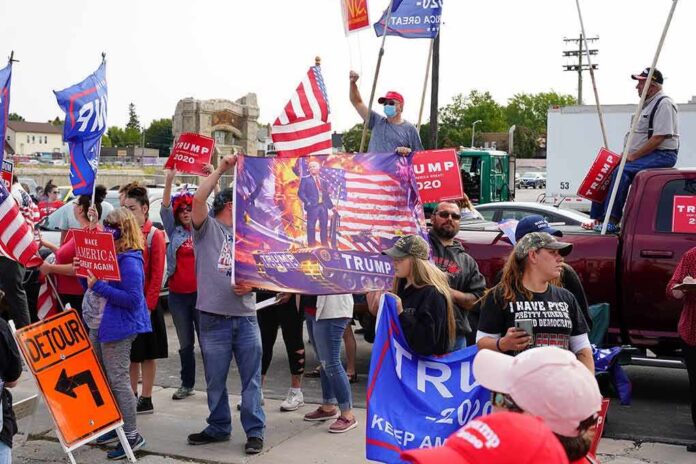
America’s political fight over MAGA is now about more than slogans, because critics say a real movement economy has grown around it.
Quick Take
- MAGA is a real political movement tied to President Trump and his base.
- The phrase “industrial complex” is a known way to describe networks that profit from politics.
- Commentary sources argue a MAGA industrial complex exists, but they mostly offer analysis, not hard records.
- The research does not show a court finding or official investigation proving a coordinated election scheme.
Why the Phrase Has Stuck
The term “industrial complex” is not new. It refers to a network of interests that can grow powerful enough to shape policy and protect its own gains. That frame has long been used for defense, tech, prisons, and other big systems. In this case, critics apply it to MAGA because the movement now reaches beyond campaigns and into media, fundraising, consulting, and donor circles.
MAGA itself is not a vague insult. It is a real right-wing political movement that began with Donald Trump’s 2016 campaign and remains tied to his political base. Supporters say it stands for America First, immigration control, and traditional values. Critics say that same brand has become a durable machine that keeps attention, money, and power flowing even after elections end.
What the Research Supports
The strongest material in the research comes from commentary, not from a formal report or court record. One podcast episode calls it “the MAGA industrial complex,” and a YouTube discussion uses the phrase “MAGA fantasy industrial complex” to argue that Trump-era myths still drive politics. Yale Insights goes further, saying Trump has taken an unusually direct role in steering private business decisions and capital flows. Those are serious claims, but they remain interpretive.
What the research does not show is equally important. It does not provide a court ruling, subpoenaed file, or election-law finding proving that MAGA operated as a single coordinated enterprise to rig elections or suppress certification. It also does not show a documented command structure with internal records, funding maps, or transaction trails. That gap matters because broad influence is not the same thing as proof of a formal racketeering-style system.
Why Conservatives Should Care
For conservative readers, the deeper issue is accountability. If a political brand can build a permanent class of influencers, consultants, donors, and vendors around itself, that machine can outlive the voters it claims to serve. The research also suggests that Trump has used federal power more aggressively inside the private sector than many free-market conservatives would like. That raises a real limited-government concern, even for supporters who back his broader agenda.
At the same time, critics should be careful not to turn every large political network into a conspiracy theory. The research shows a movement, a media ecosystem, and a set of aligned interests. It does not prove a single hidden headquarters running the whole operation. That distinction matters, because Americans can judge influence, patronage, and pressure without pretending every loose alliance is a criminal plot.
What Still Needs Proof
The best next step would be a hard audit of money, vendors, and message flow. The research itself points to that need by calling for donor-flow tracing, campaign-finance review, and network analysis of aligned media and consultants. Until that work is done, the phrase “MAGA industrial complex” remains a persuasive political frame, not a settled fact. It describes a pattern some Americans clearly see, but it does not yet rise to proven institutional misconduct.
Sources:
original.antiwar.com, en.wikipedia.org, crooked.com, ebsco.com, airandspaceforces.com, time.com, thehill.com, intereconomics.eu