
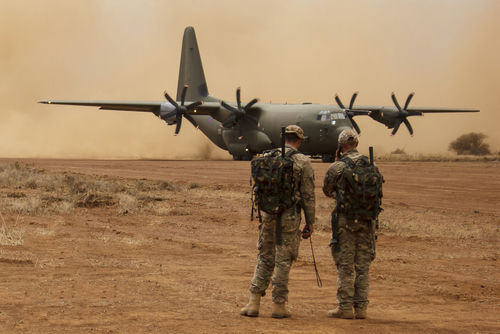
A joint U.S.–Nigeria counterterror mission targeted a top Islamic State commander in Nigeria, delivering a hard blow to jihadists while raising sharp questions about media claims and verification.
Story Highlights
- U.S. Africa Command said U.S. and Nigerian forces coordinated strikes on Islamic State targets in northeastern Nigeria. [1]
- Officials said a senior Islamic State figure, named in reports as Abu-Bilal al-Minuki (also rendered al-Manukhi/al-Barnawi), was killed. [2][3]
- Early reports said no U.S. forces were injured; assessments were still ongoing. [1][2]
- Claims of “199” terrorists killed are not supported by the cited public record. [1][2][3]
AFRICOM Confirms Joint Operation With Nigeria Against ISIS Targets
U.S. Africa Command said American and Nigerian forces conducted coordinated strikes against Islamic State militants in northeastern Nigeria, describing a joint mission executed with the Nigerian government’s cooperation. Reporting placed operations in or near Borno State, a long-contested stronghold of Islamic State’s West Africa affiliate. AFRICOM communicated that assessments were ongoing following the strikes, a standard posture after time-sensitive targeting. The command’s public acknowledgment establishes that a real, kinetic counterterrorism operation occurred—not a paper announcement. [1]
Subsequent coverage said U.S. forces and the Armed Forces of Nigeria worked in close coordination and used precision strike capabilities to hit Islamic State fighters. Outlets summarizing the government statements reported that U.S. Africa Command released video footage purportedly depicting the strike. The release of operational video is consistent with a push for transparency and deterrence, while still withholding sensitive methods. This aligns with the administration’s emphasis on decisive counterterror actions with allied partners. [2]
Senior ISIS Figure Reported Killed; Naming Variance Clouds Public Record
Administration officials and allied reporting identified the target as a senior Islamic State leader, named in various accounts as Abu-Bilal al-Minuki, Abu Bilal al-Manukhi, or Abu-Bilal al-Barnawi. Statements credited the joint operation with killing the figure and several lieutenants, characterizing the mission as a leadership decapitation strike. The transliteration variance complicates public certainty about the specific identity, but the central claim remains that a high-ranking operative directing violence in the region was neutralized by the U.S.–Nigeria team. [2][3]
The informational material filed under foreign agents registration described the action as a precision air–land operation in Borno State conducted with U.S. Africa Command coordination. That description supports a tightly planned, intelligence-driven mission rather than an improvised engagement. By emphasizing close joint planning, the record underscores how partner forces and U.S. capabilities can combine to crush jihadist nodes that threaten civilians, regional stability, and American interests. [3]
No U.S. Casualties Reported; Verification Still Ongoing
Initial statements and reporting said no U.S. personnel were injured in the operation, and some accounts added that Nigerian forces also avoided casualties. Officials stressed that full assessments were underway, leaving room for updates as post-strike analysis matured. This is the normal rhythm after complex missions: battlefield damage assessments, identity confirmation, and collateral reviews take time to complete and release. The absence of reported U.S. injuries points to careful planning and precise execution by American and Nigerian units. [1][2]
At least three Nigerian soldiers have been killed after fighters affiliated with the Islamic State West Africa Province, ISWAP, attacked a military base in northeast Nigeria, security sources and a local resident said.
The attack took place late Wednesday in Gajiganna, a town… pic.twitter.com/OBuDRSOuOW
— MMI News (@MimiMefoInfo) June 6, 2026
Conservative readers should separate the solid from the speculative. The strongest confirmed elements are the existence of the joint operation, the coordination with Nigeria, the release of strike footage, the claimed killing of a senior Islamic State leader, and the initial report of zero U.S. casualties. The weakest element is an eye-popping body count. The available cited record does not substantiate claims that “199” terrorists were killed, and officials have not published a verified tally to that effect. [1][2][3]
What This Means For U.S. Security And Accountability
The Trump administration’s counterterror posture in Africa aims to smash terror networks before they metastasize, defend persecuted communities, and protect Americans without endless nation-building. This operation, coordinated with a key regional partner, reflects that doctrine in action: targeted, partnered, time-limited, and lethal against jihadist leadership. At the same time, conservatives should insist on clarity: final identity confirmation, casualty accounting, and after-action transparency help preserve credibility and prevent the media from muddying the waters with speculation. [2][3]
The administration and Congress can reinforce trust by releasing unclassified after-action summaries, clarifying the leader’s identity spellings, and publishing a vetted casualty range once assessments close. Such steps deter terrorists, inform the public, and honor our forces’ professionalism. Precision operations that uphold the Constitution and defend innocent life deserve support—paired with facts that withstand scrutiny, not sensational numbers that hand ammunition to skeptics. Until assessments finalize, the win is clear, and the scoreboard should remain honest. [1][2][3]
Sources:
[1] Web – TRUMP’S COUNTERTERRORISM CHIEF DROPS BOMBSHELL: U.S. and Nigerian …
[2] Web – ISIS fighters in Nigeria pounded in new wave of US strikes
[3] Web – US, Nigeria strike ISIS fighters again from the air after killing …