
An alligator that evades capture for four years in a lake humans fish, boat, and swim in every summer isn’t just lucky — it’s a reminder that even in a heavily managed, decades-old hunting program, the biggest animals in the water are still mostly invisible until the night they aren’t.
Key Points
- An 844-pound, roughly 14-foot alligator nicknamed Snaggletooth was captured at Lake Moultrie, South Carolina, on the night of September 28, ending a pursuit that guide Cole Poplin says lasted four to five years.
- The catch is recognized as the second-largest alligator ever taken in South Carolina, trailing only a larger specimen from years prior.
- The team — Renegade Bowfishing’s Cole Poplin and William Ard, guiding tag holder Chris Webb and his father — identified the animal by its distinctively broken front teeth, the source of its nickname.
- South Carolina’s alligator harvest program, now three decades old, requires hunters to file measured (not estimated) length and weight, a process that shapes how “record” claims get made and compared.
- The catch lands in a season that already set a modern harvest high, underscoring a steadily recovering alligator population across the state’s coastal waterways.
What Happened at Lake Moultrie
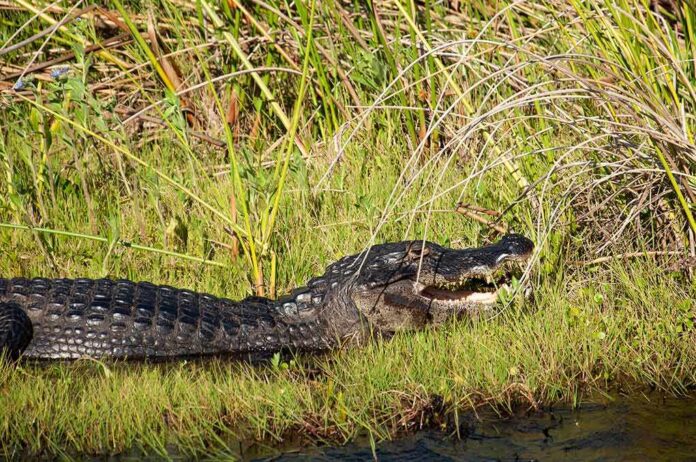
Around 11 p.m. on September 28, a four-man team hauled an 844-pound alligator out of Lake Moultrie in Berkeley County, roughly fifty miles north of Charleston. The animal, nicknamed Snaggletooth for its jagged, misaligned front teeth, measured close to 14 feet — a length that, combined with its weight, makes it the second-largest alligator ever recorded taken in South Carolina, according to the Post and Courier, which first reported the catch in detail. The crew belonged to Renegade Bowfishing: guides Cole Poplin and William Ard did the work of locating and securing the animal, while Chris Webb, who held the harvest tag, and his father were the hunters of record on the boat.
What makes the story more than a fish tale is the identification. Poplin and Ard had tracked this specific alligator for years, recognizing it by its broken front teeth in prior sightings and social media photos circulated by locals who’d glimpsed it sunning on the bank. That continuity — the same animal, spotted and lost repeatedly over multiple hunting seasons — is what turns a big catch into “Snaggletooth,” a named, storied creature rather than just another tagged harvest.
Four Years, Hundreds of Hours: Anatomy of a Pursuit
Poplin has built a guiding career on exactly this kind of patience. Earlier in the same 2026 season, his team landed a separate 770-pound alligator from the same lake, a catch Poplin attributed to “hundreds of hours of scouting” rather than chance. Snaggletooth was the harder target: by Poplin’s own account, in four to five years of effort he and Ard actually laid eyes on the animal only six or seven times. Alligators of this size are intensely territorial and almost entirely nocturnal in their movements, which means a guide’s edge comes less from equipment than from accumulated knowledge of a single stretch of shoreline, revisited obsessively, season after season, until the odds finally turn.
The physical difficulty of the catch matched the years invested in it. Renegade’s winch, rated to handle most gators over 600 pounds, stalled and began smoking partway through hauling Snaggletooth aboard — a detail Poplin recounted afterward as evidence of just how far outside normal range this particular animal sat. Guides describe alligators this large as “the last dinosaurs,” a framing that is more than marketing: an animal pushing 850 pounds represents decades of uninterrupted growth in a lake most hunters pass over every week without seeing.
How South Carolina Measures and Ranks a “Record” Gator
South Carolina’s alligator season, now in its fourth decade, runs on a public harvest-report system rather than a maintained all-time record book. The state’s harvest form instructs hunters to record carcass length in feet and inches and to enter weight only “if measured” — explicitly warning against listing an estimated figure. Total length is defined, per the state’s own hunting guide, as the distance from the tip of the nose to the end of the tail. That standard matters for context: the largest alligator reported in the entire 2023 public season statewide measured 13 feet 6 inches, against an average harvested size of just 8.9 feet. Measured against that baseline, a nearly 14-foot, 844-pound animal is not a marginal outlier — it is generations removed from a typical harvest.
The broader season numbers reinforce how unusual this specimen was. South Carolina hunters reported 467 alligators harvested in the 2025 season, the highest annual total since at least 2013, with nine of those animals reaching 13 feet or greater. The 2026 season opened on a similar trajectory. Snaggletooth, in other words, emerged from a program that is both highly active and still capable of producing an animal that dwarfs even its own strongest recent years.
Scale, Conservation History, and What the Catch Signals
To put 844 pounds in human terms: Poplin’s team compared it to a grand piano, or roughly two adult grizzly bears, stretched to the length of a sedan. Those comparisons land because American alligators have no natural predator capable of checking their growth once they clear a certain size threshold in a productive lake system — only hunting pressure, habitat limits, or old age eventually stop them. South Carolina’s current hunting program exists because the species recovered from near-extirpation; the state’s first modern alligator season in 31 years opened in just four counties in 1995, with 17 trappers harvesting 127 animals that inaugural year. The program’s expansion since then — to a statewide system harvesting hundreds of alligators annually — is itself a quiet conservation success story, one that an animal the size of Snaggletooth helps illustrate vividly: healthy, managed populations can still produce true giants.
What the catch means going forward is less about any single record and more about what it confirms: Lake Moultrie and comparable South Carolina waterways continue to harbor alligators that have gone essentially unmolested for decades, growing well past the size most hunters ever encounter. That reservoir of old, outsized animals is a direct product of sustained wildlife management rather than accident, and it suggests this won’t be the last time a guide spends years chasing a single named gator before the story ends the way this one did — in the dark, on a winch that nearly gave out, with a four-man crew finally closing a chapter that took half a decade to write.
Sources:
wjcl.com, us.headtopics.com, dc.statelibrary.sc.gov, animallaw.info, dnr.sc.gov, law.cornell.edu