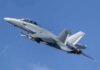


The U.S. Air Force wants a missile that can hit targets over 1,000 nautical miles away — nearly the distance from New York to Miami — and it could change how America fights in the skies and at sea.
At a Glance
- The Air Force announced a requirement for a new missile with at least a 1,000-nautical-mile range to destroy air and sea targets.
- The program, called the Air Force Long Range Weapon, is still in early stages — no aircraft platform, speed, or guidance details have been named yet.
- The Air Force’s own 2024 report warned that enemy missiles could reach the same range by 2050, making this a race against future threats.
- China’s growing arsenal of long-range missiles is widely seen as the main driver behind the new requirement.
A Missile Unlike Anything in the U.S. Arsenal
The Air Force issued an industry day notice on June 24, 2026, calling for a new weapon it’s calling the Air Force Long Range Weapon. The goal is simple: find, track, and destroy enemy aircraft and ships at extreme distances — well beyond what current missiles can do. Today’s best air-to-air missile, the Advanced Medium-Range Air-to-Air Missile (AIM-120 AMRAAM), reaches targets at a fraction of that distance.[18] A 1,000-nautical-mile weapon would be a massive leap forward.
https://www.youtube.com/watch?v=kCNDS6G7RXg
The Air Force has been building toward this idea since the early 2020s. Leadership laid out a strategy to detect and destroy mobile enemy forces at long range before they can threaten U.S. aircraft or ships.[4] This new missile is meant to make that strategy real. The AIM-260, a program already in development, is expected to outrange current missiles — but this new requirement goes much further.[5]
What We Know — and What We Don’t
The industry notice is thin on details. It sets the 1,000-nautical-mile range as the floor but says nothing about speed, payload, or guidance systems.[11] It also does not name which aircraft would carry the weapon — leaving open questions about whether jets like the F-22 or F-35 could even fit it internally.[12] Those are big gaps. A missile this large would need a capable launch platform, and no answers have been given publicly yet.
The Air Force has not released cost estimates or a full technical plan for the program. That silence has drawn some criticism from defense analysts who want more data before judging whether the 1,000-nautical-mile goal is realistic.[11] Still, the lack of public detail doesn’t mean the work hasn’t been done — it likely means the program is sensitive and still early in development.
China Is the Threat Driving This Program
The Air Force’s own December 2024 report to Congress warned that enemy forces could field anti-air missiles with a 1,000-mile range within 25 years.[13] China is the obvious concern. Beijing has developed the PL-17, a long-range air-to-air missile designed to kill U.S. radar planes and refueling tankers — the support aircraft that make American air power work. Destroying those high-value assets from a safe distance is a key part of China’s military strategy.
America needs a counter. A missile that can reach out 1,000 nautical miles gives U.S. pilots the ability to strike Chinese radar planes, command aircraft, and warships before those threats ever get close enough to endanger American jets or carriers. The Navy already fields the AIM-174B with a range of about 400 kilometers, but that falls well short of what the Air Force is now seeking.[17] This new weapon would be in a class of its own.
Why This Matters for American Security
Critics will say this program costs too much or escalates tensions. But the logic here is straightforward. If China fields a 1,000-mile missile and America doesn’t, U.S. pilots face a one-sided fight. The Trump administration has made rebuilding military strength a top priority, and closing this gap fits squarely into that mission. Letting adversaries outrange American forces is not a strategy — it’s a surrender of advantage that took decades to build.[4]
The Air Force is now asking defense contractors to weigh in on what’s possible. That’s how major programs begin. The details — cost, platform, timeline — will come as the program matures. What’s clear right now is that the Air Force sees a real and growing threat, and it’s moving to meet it head-on before the window closes.
Sources:
[4] Web – [PDF] USAF Ballistic Missile Programs (1964 -1966)
[5] Web – Air Force Wants New 1,000-Nautical Mile Range Missile for Air, Sea …
[11] Web – U.S. Air Force seeks 1,000-nautical-mile next-generation missiles
[12] Web – USAF Wants Air-To-Air Missile With A Whopping 1,000-Mile Range
[13] Web – Air Force Eyes New Stand-Off Missile with 1000-Nautical …
[17] Web – US eyes 2,000‑km air‑to‑air missile, poised to rewrite aerial warfare …
[18] YouTube – U.S. Long Range AIR-TO-AIR MISSILES will MAKE Chinese Military Assets …