
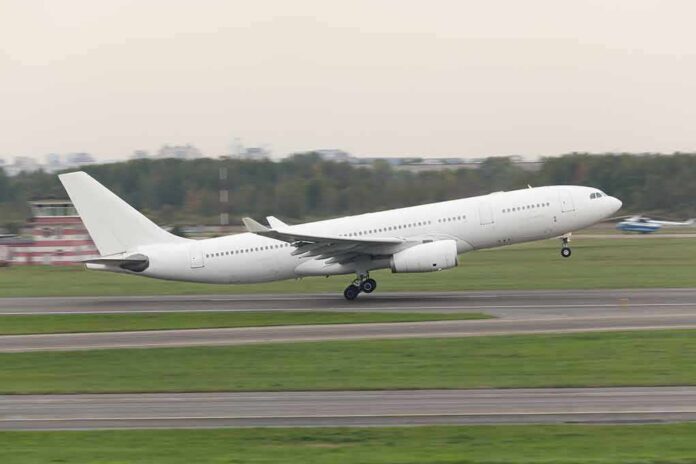
A FedEx MD-11 cargo jet ran off a Miami runway on Thanksgiving Eve, prompting a focused ground stop to keep travelers safe.
Story Highlights
- The Federal Aviation Administration (FAA) halted Miami-bound departures after a FedEx jet left the runway.
- The action targeted flights heading to Miami, not a nationwide pause.
- Miami-Dade Fire Rescue reported no injuries or medical transports.
- The FAA cited a disabled aircraft and a runway obstruction as the safety reason.
FAA Orders Targeted Ground Stop After FedEx Runway Excursion
Federal aviation officials ordered a ground stop for flights headed to Miami International Airport on Wednesday evening after a FedEx McDonnell Douglas MD-11 cargo plane went off a runway. An advisory reported by local outlets said the hold began at 8:16 p.m. Eastern and continued into the evening to protect safety while crews dealt with the disabled aircraft. The Federal Aviation Administration (FAA) described the issue as a runway and taxiway obstruction due to a disabled aircraft, a standard reason to pause inbound flow.
Reporters and wire services identified the aircraft as a FedEx MD-11, with multiple accounts using similar terms such as “overshot,” “overran,” or “skidded.” Those words all point to the same core fact: the jet departed the usable runway surface. Officials did not release the exact runway or the cause on Wednesday night. Weather, braking, surface conditions, or a mechanical problem could be factors in events like this, but no single cause has been confirmed from the available reporting.
Safety Rationale And Scope: Protect The Runway, Keep Traffic Moving Elsewhere
The FAA’s move focused on aircraft headed to Miami, rather than a nationwide clampdown or a total airport stop, which kept risk low while limiting ripple effects for other cities. Ground stops are a known traffic-management tool used when airport capacity drops due to hazards like runway closures or disabled aircraft. Agency guidance explains that ground stops require certain aircraft to remain on the ground at their origin until conditions improve and the hazard is cleared. This conservative step keeps crowded skies from getting riskier while responders work.
Runway excursions, like the event in Miami, are a known safety category separate from runway incursions. An excursion means an aircraft leaves the runway surface, while an incursion involves an unauthorized entry onto a runway. The Federal Aviation Administration outlines design, markings, lighting, and geometry changes that help cut both risks, but no design can remove all hazards when an aircraft cannot stop on the pavement. The agency’s published material on traffic flow also notes that ground stops override other measures when capacity is sharply reduced.
Thanksgiving Travel Impact And On-Scene Outcome
The timing heightened concern because millions travel for Thanksgiving. Outlets reported a continuing restriction into the late evening, but there was no confirmed tally of delays, diversions, or cancellations by night’s end. The narrow scope, which applied to Miami-bound flights, helped avoid unnecessary nationwide disruption while first responders handled the scene. Miami-Dade Fire Rescue told local media there were no injuries and no transports, a welcome outcome after any runway excursion.
Initial coverage did not confirm the aircraft’s final position or its damage level. Officials also did not release whether the jet could taxi under its own power or needed heavy equipment to move. Those details often follow later after crews secure the site and investigators gather statements and data. The National Transportation Safety Board often reviews runway excursion events; a recent board update on a separate Miami excursion shows how such probes look at braking, weather, and crew actions step by step.
What Comes Next: Clearing The Runway And Fact-Finding
Airport crews typically stabilize the aircraft, inspect pavement, and remove debris before reopening the full runway length. The FAA can then lift the hold as capacity returns. In many cases, investigators gather voice and data recordings, weather readings, and maintenance logs to map the sequence. The FAA’s runway safety pages show why these checks matter: better markings, lighting, and geometry reduce risks, but controllers and crews still rely on clear runways to land and stop safely.
Close-up footage captures a FedEx cargo plane resting near a perimeter fence and busy roadway after overrunning Runway 26R at Miami International Airport on Wednesday night. FedEx Flight 910—a McDonnell Douglas MD-11 arriving from Memphis—skidded off the pavement amid wind and…
— tippinsights (@TippInsightsHQ) November 26, 2026
For travelers, the lesson is simple: when a runway is blocked, safety comes first, and the pause is temporary by design. For Miami’s busy holiday rush, the focused ground stop balanced safety with common sense, keeping the issue local while protecting people in the air and on the ground. Officials had not released a cause as of Wednesday night, and that is normal so early. What is clear is that the system did what it should: slow down, clear the hazard, and then get America moving again.
Sources:
thegatewaypundit.com, cbs12.com, mobil.aa.com.tr, iheart.com, vinnews.com, washingtonexaminer.com, faa.gov, ntsb.gov