

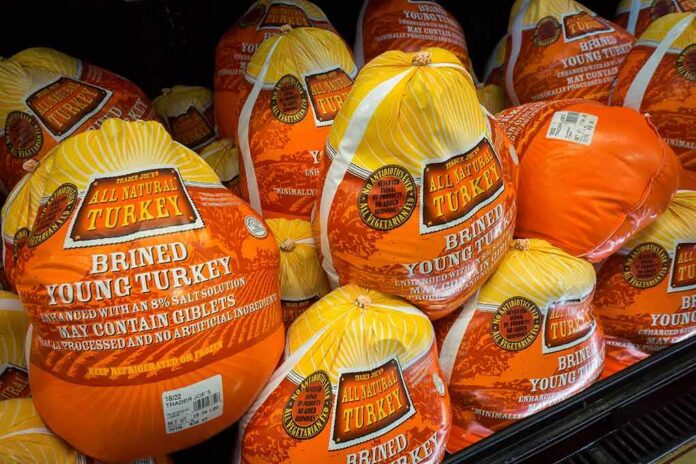
The fastest way to tank Thanksgiving is to wash your turkey and spray germs across your kitchen.
Story Snapshot
- United States Department of Agriculture says do not wash raw turkey; it spreads bacteria.
- Cook turkey to 165 degrees Fahrenheit and check three spots with a thermometer.
- Keep raw juices away from salads, sides, and clean anything the turkey touches.
- Most people still rinse birds, but the splash pattern moves germs around the room.
Why Washing Turkey Backfires Every Time
The United States Department of Agriculture urges home cooks to skip rinsing raw poultry because water does not remove germs from skin or crevices. It blasts tiny droplets that carry bacteria onto sinks, counters, utensils, and nearby food. That is cross-contamination. A quick rinse feels clean, but it seeds risk where you least expect it. Lab work shows splashes move bacteria away from the bird and onto surfaces that later touch ready-to-eat food. Tradition meets physics, and physics wins.
Most households still wash raw birds out of habit or belief in freshness. Federal survey data show many shoppers rinse whole turkeys or chickens before cooking. Public health researchers also find most people who wash poultry do not know experts call it unsafe. Good intent does not offset a bad method. The sink turns into a launch pad, and your salad, rolls, or fruit tray can pay the price. That is why experts push prevention over cleanup.
The Single Non-Negotiable: 165 Degrees Fahrenheit
Cooking to a safe internal temperature kills the germs that make people sick. The Food Safety and Inspection Service says a turkey is safe when it hits 165 degrees Fahrenheit in three places: the thickest part of the breast, the innermost thigh, and the innermost wing. The United States Department of Agriculture adds that a food thermometer is the only way to know you are there. Guessing by color or juices is a coin flip. Check all three spots and write “165” into your game plan.
People often ask if brining, smoking, or spatchcocking changes the rule. The method can change how fast parts heat up, but not the target. Dark meat lags behind white meat, which fools many cooks. Move the probe around to confirm the slowest zone. If stuffing is in the bird, that center also needs to reach 165 degrees, or you are serving a Petri dish. Cooking does the killing. Washing only spreads the problem.
Build a Clean Zone, Not a Clean Myth
Set up the counter before the turkey leaves its wrap. Keep raw turkey and its tray away from foods that will not be cooked, like salads, fruit, and desserts. Use a cutting board just for raw poultry. Open the package in the sink, let the juices drain, and go straight to the pan. Do not touch cabinet pulls, spice jars, or phones with turkey hands. If something gets touched, wash it. This sounds fussy. It is cheaper than a night in the bathroom.
Wash hands with soap and warm water for 20 seconds before and after handling raw turkey. Clean and sanitize the sink, faucet, and any surface or tool that touched the bird or its juices. The United States Department of Agriculture reminds cooks that raw poultry juices can move harmful bacteria onto anything nearby. Their roasting guide hammers the same point: always wash hands, utensils, and the sink after contact with raw turkey. Routines beat luck every time.
Thaw Smart, Prep Straight, Carve Clean
Thawing sets the tone. Use the refrigerator, cold water with sealed packaging and frequent water changes, or a microwave that you cook right after. Do not thaw on the counter. Keep the raw bird separate from ready foods while you season. Dry the skin with disposable towels if you want crisp skin. Toss the towels right away. Skip any rinse. Place the turkey in a roasting pan, go to the oven, and start your timer. Simple beats dramatic.
A turkey fed every day for 1,000 days grows more confident daily, right up until Thanksgiving. A calm streak isn't proof of safety. pic.twitter.com/Bj1fWHybD1
— Jacked | Money & Mental models (@thinkbizmoney) November 22, 2026
After roasting, rest the turkey, then carve with a clean board and knife that did not touch it raw. Move leftovers into shallow containers within two hours and refrigerate. On reheat, bring turkey and gravy back to 165 degrees Fahrenheit. These steps match the common-sense approach many American families value: clear rules, personal responsibility, and results you can taste. Clean zones prevent spread, thermometers confirm safety, and your guests leave happy and well.
Sources:
washingtontimes.com, fsis.usda.gov, usda.gov, ars.usda.gov, pubmed.ncbi.nlm.nih.gov