

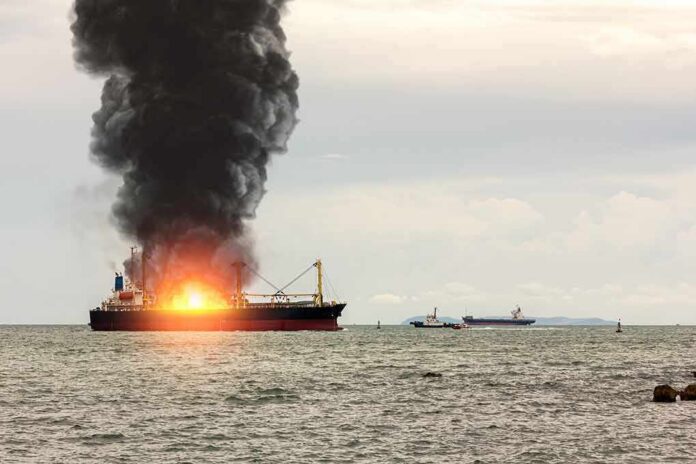
Yemen’s Houthis said they fired ballistic missiles at a Saudi oil tanker in the Red Sea, pushing their declared maritime blockade deeper into one of the world’s busiest shipping lanes.
Quick Take
- The Houthis said they hit the tanker Wafa off Yanbu with ballistic missiles.
- The group said the strike was part of its declared maritime blockade of Saudi Arabia.
- Multiple outlets repeated the Houthi claim on the same day, but public independent verification was limited.
- The Houthis said the Wafa incident was the eighth Saudi oil tanker targeted since July 22.
Houthis Claim New Strike Off Yanbu
Houthi military spokesman Yahya Saree said the group targeted the Saudi oil tanker Wafa off the coast of Yanbu with ballistic missiles. He said the strike was “precise” and tied it to the group’s ongoing maritime campaign against Saudi-linked shipping. Several outlets repeated the claim, including Reuters, the English-language state news service from China, Al Jazeera, and other regional broadcasters.
The reported attack fits a pattern the Houthis have used for weeks. They have framed their actions as a “blockade for a blockade,” saying Saudi Arabia must pay a shipping price for its policies. The group also said the Wafa strike was the eighth Saudi oil tanker hit since the blockade began on July 22, a figure that appears in several reports but was not independently verified in the available material.
What the Reports Say, and What They Do Not
The strongest confirmed fact in the record is the Houthi claim itself. The available reporting does not include a vessel operator statement, a damage report, or public forensic proof that the tanker was actually hit. Some outlets identified the ship as Wafa, while others used Wafaa or described it only as a Saudi tanker, which leaves some naming uncertainty in the public record.
That gap matters because Red Sea shipping incidents often move faster than the evidence. In earlier Houthi claims, maritime monitors did report separate incident details, including an “unknown projectile” and a fire on a Saudi tanker, but those reports concerned earlier vessels and earlier dates, not the Wafa event itself. The new claim therefore stands on the Houthis’ own statement for now, even as it travels quickly through the news cycle.
Why the Red Sea Remains a Flashpoint
The Red Sea has become a stage for information warfare as much as naval disruption. Houthi statements are designed to influence shipping behavior immediately, before full incident checks can be completed. That makes the public message powerful, even when the physical facts are still unclear. Saudi officials had not provided an immediate public confirmation in the reporting available here, leaving a vacuum that only increases speculation around the incident.
Six Saudi-flagged supertankers abandoned Bab al-Mandeb after the Houthis declared a maritime embargo on July 20, rerouting around the Cape of Good Hope and adding at least 25 days to their return journey.
Each vessel can carry two million barrels of crude.
The detour,…— The Levantine (@levantinereport) August 4, 2026
For shipping firms, insurers, and regional governments, the practical risk is the same: every claim of a strike can alter routing, raise costs, and shake confidence. The political message is also plain. The Houthis are trying to project control over a major trade corridor while wrapping each attack in blockade language. For readers tired of weak borders, high energy costs, and global instability, the story shows how fast one armed group can threaten commerce that supports everyday life.
Sources:
yahoo.com, jfeed.com, anews.com.tr, caliber.az, aljazeera.com, instagram.com, english.news.cn, en.wikipedia.org, theguardian.com