

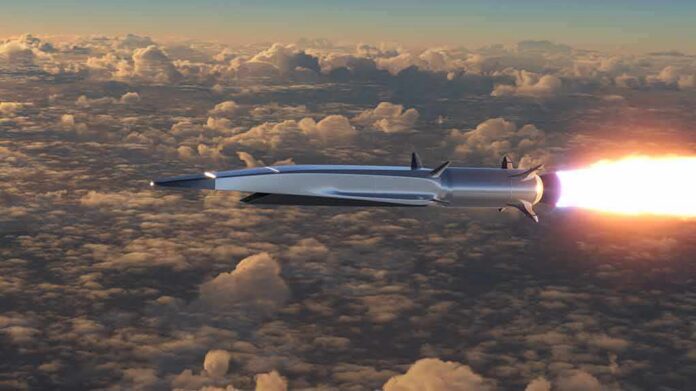
A Navy order worth up to $200 million moves a new American hypersonic missile into production for the fleet.
Story Highlights
- The U.S. Navy issued a production delivery order valued up to $200 million for Blackbeard hypersonic weapons.
- Castelion says this order follows 50 Early Operational Capability weapons already on contract.
- Reuters previously reported a $105 million Navy award tied to carrier-based F/A-18 integration.
- The program advances under Small Business Innovation Research Phase III authorities.
Navy Order Transitions Blackbeard From Prototypes To Production
Castelion announced the U.S. Navy placed a production delivery order valued at up to $200 million for Blackbeard hypersonic weapons. The company said the order covers manufacturing, assembly, testing, and delivery of an initial production lot for fleet use. The company framed the action as a production transition under a Small Business Innovation Research Phase III pathway, which allows procurement of products that mature from earlier research efforts. Castelion’s announcement is the primary on-record description of scope and value.
The company also said the new order follows 50 Early Operational Capability weapons previously ordered in June. Castelion lists earlier Navy awards on its website, including firm fixed price orders that pushed Blackbeard toward initial fielding. Those prior actions built a path for fast transition from design to usable rounds. Today’s step signals a shift toward scaled delivery rather than small test batches. The Navy is working to speed useful capability to carrier air wings as threats grow in the Pacific.
Separate Award Reported For Carrier Jet Integration
Reuters reported in April that the Navy awarded $105 million to get Blackbeard ready for use on carrier-based F/A-18 fighter jets. That report described integration work for the carrier air wing mission, which is central to Navy strike options. The new production delivery order described by Castelion appears to be a separate action focused on building missiles. The public materials do not include a Navy contract number or funding profile linking the two actions in one document.
Small Business Innovation Research Phase III rules permit direct awards for production and services that derive from earlier research work. The Department of Defense explains that Phase III can cover products, test and evaluation, or production, and is funded with regular program dollars rather than research funds. That pathway is designed to speed promising technology into the hands of warfighters. The Navy has used it in several programs to shrink timelines that often stretch for years.
How Blackbeard Fits The Hypersonic Push
Blackbeard is pitched as a lower-cost, air-launched hypersonic strike option that can fly from existing Navy jets. That approach could give carrier groups a fast strike tool without waiting on larger, far more expensive missile families. The Congressional Budget Office has shown how hypersonic weapons can drive very high totals over time, which makes lower unit cost a key factor for scaling inventory. A carrier-ready round that is affordable to build and maintain supports fleet readiness at real volume.
Accelerated acquisition has trade-offs. Government Accountability Office reviews show that rapid pathways can add schedule and cost risk if leaders skip proven practices. The method still seeks to deliver capability sooner than legacy processes, which struggled under long timelines and high prices. The Blackbeard path, moving from early operational rounds to production under Phase III authority, reflects this push to field workable weapons faster while demand for range and speed rises across the Indo-Pacific.
What This Means For Deterrence And Industry
A production order signals confidence that the design is mature enough to build at scale and hand to squadrons. That supports President Trump’s focus on rebuilding deterrence through strength and speed. A hypersonic strike option on the F/A-18 extends the reach of carrier air wings and complicates an enemy’s air defenses. It also rewards an American small business that moved from research to production, showing a healthy defense base that can deliver under pressure and competition.
🚀 The US Navy awarded @Castelion a production contract worth up to $200M for over 400 of its Blackbeard hypersonic missiles, which COO Sean Pitt told Tectonic was executed under the Navy's MACE program for integration with the F/A-18.
🔗 Full story from @barratt_dewey below pic.twitter.com/Sm0cfjliCZ
— Tectonic (@tectonicdefense) September 16, 2026
Taxpayers should demand value as the Navy ramps up quantities. Phase III lets the service buy quickly, but leaders must still prove performance and keep unit costs in check. Reuters’ reporting on the earlier $105 million award for integration and Castelion’s statement on the up to $200 million production delivery order frame a clear sequence: get the weapon onto the jet, then build rounds for the fleet. The Navy has not released the contract paperwork publicly, so funding details and exact quantities were not provided in these sources.
Sources:
castelion.com, tipranks.com, reuters.com