

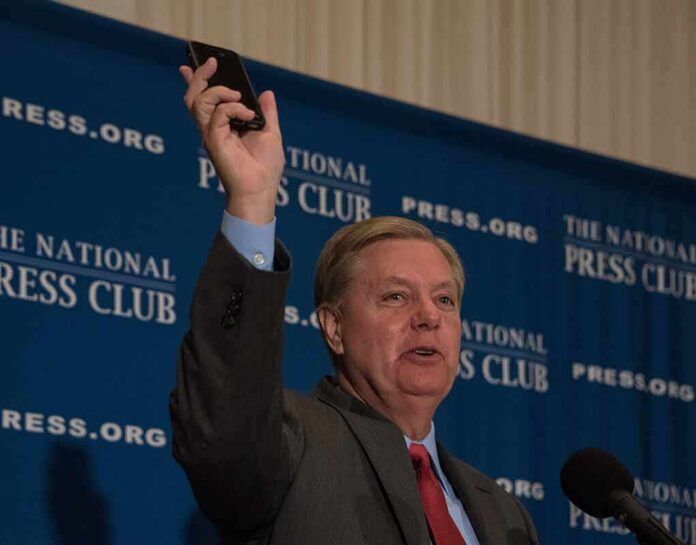
The sudden death of Senator Lindsey Graham removes one of Washington’s loudest war hawks, forcing Republicans and President Trump to decide how far America should keep policing the world without him.
Story Snapshot
- Graham was a leading voice for aggressive foreign policy, backing wars, sanctions, and endless aid abroad.
- His passing leaves a power vacuum between Trump’s America First base and old-guard hawks who still want deep global intervention.
- Trump’s second-term foreign policy now faces a key test: follow voter demands for restraint or keep Graham’s costly overseas agenda alive.
- Conservatives worry allies like Ukraine and Israel will push harder for U.S. action, even as many Americans are tired of “forever wars.”
Graham’s Long Shadow Over American Foreign Policy
For more than twenty years, Senator Lindsey Graham was one of the most aggressive foreign policy voices in the Republican Party, pushing military action, sanctions, and deep alliance commitments almost as a default answer to every crisis. He backed the Iraq War, the surge of extra troops there, intervention in Libya, and harder lines on Syria and Iran, often calling for more bombing or even ground troops. He saw American power as something to be used around the globe, not held back.
Graham did not just support wars in general; he was specific and tireless. He pressed for tens of thousands of American troops against the Islamic State and argued for regime change in Tehran and Damascus. He consistently backed Ukraine’s goal of joining the North Atlantic Treaty Organization (NATO), supported sanctions and weapons for Kyiv, and pushed for war-crimes trials for Russian leaders. He was also one of Israel’s strongest backers in Congress, defending its military campaigns and urging tougher action on Iran’s nuclear and missile programs.
A Sudden Void in a Divided Republican Party
Graham’s death at seventy-one came just after he returned from another trip to Ukraine, where he met President Volodymyr Zelensky and visited a drone plant, underscoring how involved he remained to the end. His passing leaves Trump-era Republicans split between an America First base that is skeptical of foreign adventures and an older national-security wing that still believes in a muscular, global U.S. role. Many party activists want to focus on borders, crime, energy prices, and inflation at home, not nation-building overseas.
Analysts note that Graham sat in a unique spot: he was both a strong supporter of Trump and a die-hard hawk who tried to steer the president toward more aggressive action on Iran, Russia, and other rivals. He urged Trump to take “all in” measures to stop Iran from getting a nuclear weapon, cheered strikes on Iranian nuclear sites, and backed tough sanctions. Yet Trump’s foreign policy already departed from the old bipartisan consensus when he returned to the White House in 2025, centering power on protecting American sovereignty rather than global management. That shift suggests the broader direction comes from voters and the president, not from one senator alone.
Foreign Policy After Graham: Pressure From Hawks, Patience From Voters
Commentators claim Graham’s death could mark “the end of an era” of interventionist foreign policy, but research on leadership changes shows that one person’s departure rarely flips a country’s entire strategy without deeper ideological change. Other hawkish Republicans, former officials, and conservative activists have already signed letters urging more military aid to Ukraine, proving that pro-intervention voices still exist inside the party. At the same time, think tanks and scholars point to growing domestic polarization and fatigue with endless conflicts, which pushes leaders to focus more on problems at home.
Senate passes unanimous resolution honoring Sen. Lindsey Graham. ALL 99 colleagues cosponsored S. Res. 801, despite Graham's controversial remarks on foreign policy, segregation and LGBTQ+ rights. #Senate #LindseyGraham
— Legis1 Congress Update (@CongressUpdate) July 15, 2026
Trump’s second term has already broken with the post–World War II foreign policy consensus, and many conservative voters welcome that break. They are tired of being told that America must pay for every distant fight while our own border is porous, our energy costs rise, and our debt explodes. Graham’s absence removes one of the strongest voices arguing that U.S. troops and taxpayer dollars should be sent abroad again and again. The battle inside the GOP—hawks versus restraint advocates—will now play out without his constant push for more intervention.
Sources:
realcleardefense.com, foxnews.com, abcnews4.com, latimes.com, townhall.com, en.wikipedia.org, easternherald.com, marca.com, independent.co.uk, instagram.com, facebook.com, aljazeera.com, politico.com, responsiblestatecraft.org, svgn.io, youtube.com, usatoday.com, pmc.ncbi.nlm.nih.gov, slouchingcolumbia.wordpress.com