
When a dump truck and a delivery e-bike meet on a Manhattan arterial, physics decides the outcome long before blame is assigned: sheer mass and blind spots turn a routine conflict into a fatality. That is the central, durable truth behind a Midtown crash that killed a 50-year-old woman near Herald Square — and a pattern cities continue to struggle to tame.
At a Glance
- NYPD says a dump truck struck a cyclist on West 34th Street near Seventh Avenue around 10:50 a.m.; the rider died at the scene
- The dump truck continued westbound; police located and stopped it at Fifth Avenue and 35th Street and impounded the vehicle
- Police questioned the 36-year-old driver; no charges were filed at that time while the investigation continued
- Crashes involving heavy trucks disproportionately kill cyclists in dense urban settings, especially during turning and curb-adjacent maneuvers
What Happened on West 34th Street
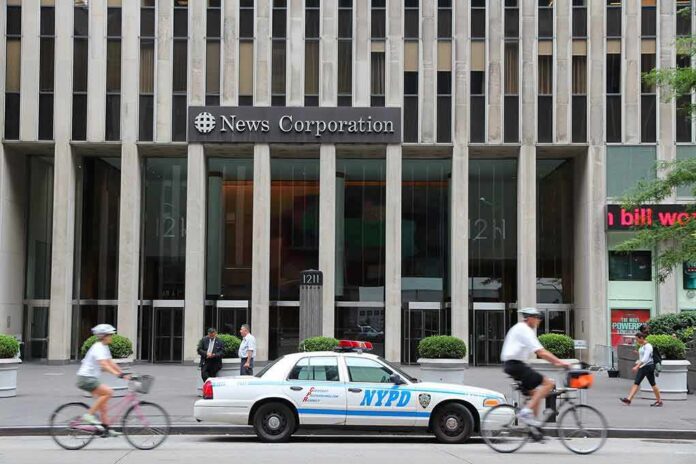
Late in the morning on West 34th Street — the spine that threads Macy’s Herald Square to Penn Station — NYPD officials say a dump truck and an e-bike rider were traveling westbound near Seventh Avenue when the truck collided with the cyclist. EMS arrived quickly, but the rider, described by police as a 50-year-old woman, was pronounced dead at the scene. The truck did not remain; it continued west on 34th. Within minutes, officers armed with a vehicle description located and stopped a New Jersey–plated dump truck around the corner at Fifth Avenue and 35th Street. Police impounded the vehicle and questioned the 36-year-old driver. Investigators indicated the driver would be released with no charges at that time as the inquiry proceeded.
The geography matters. Thirty-Fourth Street compresses multiple bus routes, dense foot traffic, sprawling loading zones, and a conveyor-belt rhythm of deliveries. Even modest driver error can carry catastrophic consequence when an 80,000-pound truck shares space with a person on a bicycle, particularly a delivery e-bike whose job forces it to hug the curb, thread gaps near turning vehicles, and enter and exit loading interfaces repeatedly.
Why Heavy Trucks So Often Feature in Cyclist Fatalities
Across cities, a familiar asymmetry emerges: heavy trucks account for a small fraction of vehicle mileage yet a large fraction of cyclist deaths, with the imbalance most pronounced in urban corridors and at intersections. Peer-reviewed work and national safety syntheses converge on the mechanism — high cabs and set-back mirrors create frontal and lateral blind zones; long wheelbases produce “squeeze” conflicts at turns; and even at low travel speeds, a secondary run-over after an initial knockdown often causes fatal trauma. In urban case series, heavy vehicles are implicated in roughly a third of cyclist fatalities, and turning maneuvers dominate the fatal configurations.
Delivery riders are structurally exposed. Their trips cluster at the curb where trucks load, turn, and queue; signal phases push them to advance with buses and large vehicles; and the time pressure of piecework pay keeps them moving through complex gaps. In several datasets, low-speed, intersection-involved collisions — not highway-speed impacts — are overrepresented in urban cyclist deaths, a counterintuitive but consistent finding explained by the geometry of trucks and the physics of knockdown-and-overrun events.
The Street, the Vehicle, and the Human Factors
Mechanism is never just one variable. Street design channels behavior: curb-adjacent bike lanes alongside general traffic create exposure to right-turning trucks; offset loading bays and construction staging bleed vehicles into and across micromobility space. The vehicle platform sets the stakes: a conventional North American dump truck typically places the driver high and forward, with significant nearside blind spots and limited direct vision along the passenger-side door line. Human factors convert exposure into events: scanning failures at turn onset, late commitment to a lane change, and misjudged bicycle approach speed — especially with e-bikes, which often travel faster than drivers anticipate — can collapse the safety margin in a heartbeat.
Crucially, severity is largely predetermined by mass and under-ride dynamics. A cyclist who falls adjacent to a long wheelbase may be swept beneath axles even when the initial contact occurs at modest speed. That is why heavy vehicle reforms in Europe have emphasized direct-vision cabs, nearside window cut-downs, sensors with active braking, and side guards that block under-run. The gains do not depend on perfect human performance; they reduce the lethality of predictable human error.
How New York Investigations Typically Proceed
When a fatal crash occurs, NYPD’s Collision Investigation Squad works a familiar sequence: secure and document the scene; interview the driver and witnesses; canvass for cameras on adjacent blocks; and obtain vehicle data if available. In this case, police rapidly located a truck matching the broadcast description and impounded it while questioning the driver, steps consistent with standard protocol. Public reporting identified the location, approximate time, direction of travel, and initial status of the driver and vehicle, while indicating that charging decisions had not been made at the time of initial statements.
On corridors like West 34th Street, investigators often supplement on-scene measurements with traffic signal timing, bus-cam or retail-camera video, and fleet telematics. That evidence base can resolve key unknowns: lane position, turn initiation, and vehicle speed. Prosecutors then assess intent and culpability under New York’s vehicular statutes, which draw fine distinctions among failure-to-yield, leaving the scene, and higher-level offenses when recklessness is established.
What Evidence Says Works to Prevent These Crashes
Three levers consistently pay dividends. First, vehicle design: direct-vision standards, nearside glazing, 360-degree cameras, proximity sensors with intelligent braking, and side underrun guards reduce blind spots and prevent overrun — particularly during slow-speed turns. Second, street operations: protected intersections that square up turns, set-back bike crossings that move cyclists out of the pinch point, dedicated signal phases that separate truck turns from straight-through cycling movements, and freight plans that rationalize loading on dense corridors to cut down unpredictable curb maneuvers. Third, rules and accountability: predictable enforcement of failure-to-yield and large-vehicle operating requirements, plus contracting standards that require safety tech on municipal and utility fleets, shift norms across the market.
None of this erases the realities of a commercial street like 34th: buses must dock; trucks must deliver; riders must earn a living. But the record is clear: where cities harden conflict points and fleets upgrade cabs, fatalities fall. The safe-system premise — design for human error without accepting human death — is not a slogan; it is an engineering constraint that heavy-vehicle corridors must finally treat as nonnegotiable.
The Stakes on a Midtown Arterial
The woman who died alongside Herald Square was doing what thousands do every day in New York: riding to deliver a meal on a corridor built first for trucks and buses. Police moved quickly to find the implicated dump truck and are continuing their investigation; the facts on 34th Street align with a national pattern that policy can blunt but has not yet conquered. The uncomfortable constant is this: in mixed traffic, the consequences of a split-second miss between a heavy truck and a cyclist are not measured in fender damage. They are measured in lives.
Sources:
nypost.com, audacy.com, centsondollar.com, nyc.streetsblog.org