

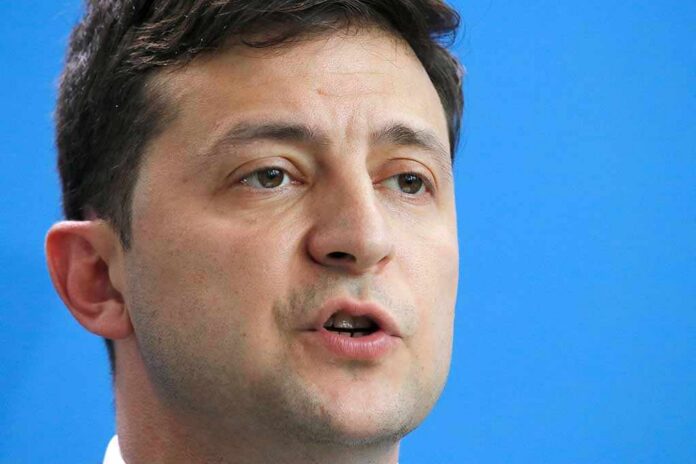
Ukraine’s President Volodymyr Zelenskyy addressed Norway’s Parliament during a historic session tied to a multi‑year support program for Ukraine, underscoring Oslo’s deep, ongoing aid commitment.
Story Highlights
- Zelenskyy spoke at a historic session connected to Norway’s multi‑year Ukraine support plan.
- Norway’s leaders described broad parliamentary backing for sustained military and economic aid.
- Recent meetings reaffirmed a strategic partnership and expanding assistance to Ukraine.
- The event reflects a wider European push to bolster Kyiv amid heavy information warfare.
Zelenskyy’s Address Linked to Norway’s Parliament and Aid Framework
Norway’s government recorded that Zelenskyy addressed a historic session involving the Storting, Norway’s Parliament, during the launch of a multi‑year support program for Ukraine. The Norwegian Prime Minister welcomed Zelenskyy and noted the occasion’s significance. The same official record describes Parliament’s role in backing the package. This shows Zelenskyy’s remarks were not a side event. They were tied to a landmark plan that set Norway’s long‑term course to aid Ukraine’s defense and recovery.
Norway’s approach centers on stable, multi‑year help rather than one‑off gestures. Norwegian leaders have repeatedly described wide parliamentary agreement behind major funding and deliveries. Government statements across 2023 to 2026 outline long‑term political, military, economic, and humanitarian support. Leaders also point to concrete items like artillery ammunition, drones, and investments in Ukraine’s defense industry. These details show the plan has teeth, not just speeches or slogans. Oslo has framed this as a durable commitment.
Recent Commitments Underscore a Strategic Partnership
Norway’s Prime Minister said in February 2026 that Norway and Ukraine agreed to form a “strategic partnership” and develop it across several areas. That announcement came during a joint appearance with Zelenskyy and highlighted the forward path for security and industry cooperation. Norwegian leaders have also emphasized that Parliament’s support remains broad, which signals sustained policy rather than short swings. The consistent tone suggests Norway intends to stay a key backer of Kyiv.
In April 2026, the Prime Minister publicly welcomed Zelenskyy again and referred to him as a partner and friend, marking at least the fourth official visit to Norway. The Prime Minister linked these meetings to Norway’s broader backing and to practical defense cooperation. These gatherings track with earlier statements that Norway had more than doubled or tripled Ukraine support at different points. The pattern points to growing depth and planning rather than ad hoc aid.
Why This Matters to U.S. Conservatives Watching Europe
Allies that pay more for their own defense ease pressure on American taxpayers. Norway’s long‑term plan shows a European partner shouldering real costs and risk. That aligns with the principle of shared burden within alliances. Stronger European resolve can help deter aggression, limit wider conflict, and reduce requests that Washington often receives to fill every gap. When Europe steps up, America can focus resources at home while keeping faith with core security interests.
Clear records matter too. Political images and videos online often mislead, especially in wartime. Studies of synthetic media on social platforms show a high share of political content among fake or altered videos. One review found the majority of sampled artificial videos on a major platform were political, which fuels confusion. Relying on primary government records—like Norway’s log of Zelenskyy’s parliamentary link—helps cut through noise and keeps the facts straight.
The Nansen Framework and Parliament’s Central Role
Norway tied Zelenskyy’s address to the launch of a multi‑year support program, often described by officials as a Nansen package. The government’s account places the Parliament at the center of that decision. Leaders highlighted a broad majority within the Storting backing the plan, which gives it democratic weight and predictability. This structure matters because Ukraine needs long‑lead items, steady funding, and industrial orders. Norway connected speeches, votes, and deliveries in a single, public track.
Nordic Countries Don't Trust Putin!
Speaking after meeting Nordic leaders, @ZelenskyyUa praised Denmark, Sweden, Norway, Finland and Iceland for their deep understanding of Ukraine's security challenges and their continued support against Russia's invasion.
But his strongest… pic.twitter.com/iSMelh6DbB— euDebates.tv (@eudebates) November 11, 2026
For readers wary of endless foreign spending, the key test is accountability and results. Norway’s public records point to specific aid lines and recurring check‑ins with Ukrainian leaders. That model offers a clearer yardstick for measuring value. When allies document commitments, citizens can judge if money and material reach the front and speed an end to the war. Transparent, time‑bound support—voted on by a legislature—beats open‑ended promises made in private.
Sources:
regjeringen.no, ar5iv.labs.arxiv.org, academic.oup.com, pmc.ncbi.nlm.nih.gov