
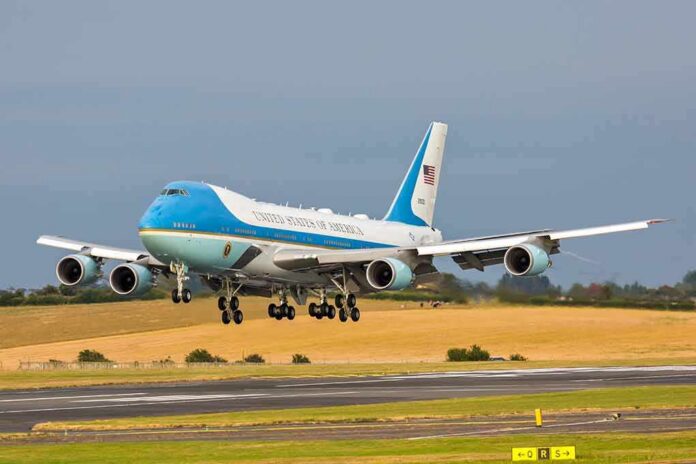
Senators say a foreign government’s $400 million “gift” airplane for President Trump may violate the Constitution and could expose security gaps, even as the Air Force declares it mission-ready.
Story Highlights
- Senators warned that accepting Qatar’s $400 million jet without consent may breach the Foreign Emoluments Clause.
- The Air Force says the bridge aircraft finished modifications and flight testing and is safe for presidential missions.
- Reports questioned whether the rapid retrofit deferred some defensive systems, prompting plans for more upgrades.
- Taxpayers still face significant costs to modify and operate the donated Boeing 747-8 aircraft.
What sparked the fight: a foreign “gift” with constitutional strings
Senate materials argued that taking a high-value jet from Qatar without explicit congressional consent risks an illegal emolument under Article I, Section 9, Clause 8. Senate Resolution 244 called acceptance an “illegal emolument” and warned of foreign influence and national security risks. The Congressional Record reflects those claims and frames the plane’s value as extraordinary, heightening concerns about influence and control over its disposition.
Pentagon officials countered that Qatar’s transfer was an unconditional gift to the United States, not to President Trump personally. A Defense Department spokesman said Defense Secretary Pete Hegseth accepted the aircraft under federal rules and that the department would ensure all security and mission needs are met before presidential use. That position places the gift within existing law and policy, pending congressional oversight outcomes.
How fast the jet was modified, and why that matters
The Air Force said the bridge aircraft completed modification and flight testing before entering service. Officials credited contractor L3Harris for secure communications, self-protection expertise, and complex VIP aircraft work. The service described the plane as safe, secure, and equipped with advanced technology for the presidential mission. It also said no risk was accepted in security, safety, or mission communications, though trades were made in less common mission sets.
Outside reporting said the compressed schedule raised questions about whether every defensive measure was installed before operations. Reuters noted that experts wondered if accelerated work left the jet less secure than the current fleet, and Breaking Defense reported that the plane would be taken offline later for “maxed out” upgrades, including alleged defensive shortfalls. These claims remain partly obscured by classification and limited public detail.
Who pays, who benefits, and who decides
Even with a free airframe, taxpayers still fund significant modifications, testing, crews, training, and support. Air Force updates cited a major bridge-aircraft integration effort, and public statements pegged modification costs below $400 million. The final tally, full cost breakdown, and life-cycle expenses are not yet public, which fuels concerns about opaque spending and rushed decisions that can favor contractors over taxpayers.
It’s all becomes Government property…
President Donald Trump received a luxury Boeing 747-8 jet as a gift from the Qatari royal family (Amir Tamim of Qatar) to the U.S. Department of Defense to be used as an interim…
— OnGod’sSide (@ClaudetteC98576) November 10, 2026
Senator Chris Murphy pressed the Air Force and L3Harris for the transfer agreement, security details, and any memorandum of understanding with Qatar. His letter highlighted gaps on ownership, valuation, and conditions tied to acceptance. The Senate resolution also asked whether the plane’s future disposal could benefit a presidential library. Officials have deflected on some points, citing classification, leaving both legal and security debates unresolved in public view.
Why both left and right see a deeper problem
Many Americans see a pattern: big decisions made fast, with few answers on who is accountable. Supporters of President Trump view the jet as a smart bridge while purpose-built replacements lag. Critics see a risky foreign gift that could invite influence. Both sides worry that secret processes, elite dealmaking, and blurred lines between public duty and private gain erode trust. Until documents and testable facts surface, the fight will likely harden, not heal.
Sources:
feedpress.me, afrc.af.mil, congress.gov, murphy.senate.gov, reuters.com, heraldtribune.com, bbc.com, cnbc.com, apnews.com