
President Trump unveiled a $200 billion South Korean investment package Wednesday that will fund new American nuclear plants, a Texas gas-power facility, and a long-stalled Alaska gas pipeline.
Quick Take
- President Trump announced South Korea will invest roughly $200 billion in U.S. energy projects.
- The deal includes a Texas gas power plant, eight new nuclear plants, and the Alaska LNG pipeline.
- South Korea says Alaska’s $54 billion piece still needs to pass a commercial viability review.
- The package builds on a $350 billion trade deal that already cut tariffs on Korean goods to 15%.
Trump Unveils Massive Korean Energy Package
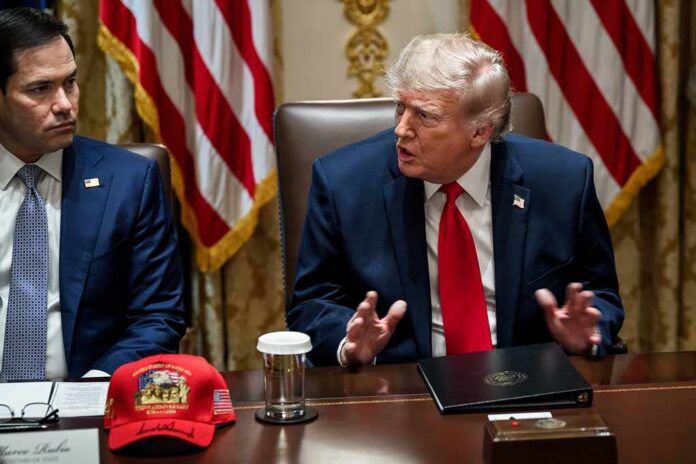
President Trump announced Wednesday that South Korea agreed to pour about $200 billion into American energy projects. The announcement, made from the Oval Office, covers a new gas power plant in Texas, eight nuclear plants, and a natural gas export pipeline in Alaska. It marks one of the largest single foreign investment pledges of his second term and a direct payoff from last year’s trade negotiations with Seoul.
The Texas project alone carries a price tag of $22.3 billion. It will build a six-gigawatt gas-fired power plant in Encinal, Texas, designed to run artificial intelligence data centers starting in 2029. That single plant shows how the administration is tying new energy capacity directly to the booming demand for computing power driving America’s tech industry forward.
Alaska Pipeline Gets Long-Awaited Boost
The biggest political prize may be the Alaska piece. South Korea pledged roughly $54 billion toward an 807-mile natural gas pipeline connecting Alaska’s North Slope oil fields to export terminals, a project Republican lawmakers have pushed for years. Alaska Senator Dan Sullivan, who faces a tough reelection fight next year, stood beside President Trump during the announcement, underscoring how badly the state wants this project built.
South Korea’s government quickly added a condition. Officials in Seoul said the Alaska pipeline will only move forward once the project clears a commercial viability review and meets the country’s own legal requirements. That caveat does not undo the announcement, but it does mean the Alaska funding is not yet locked in the way the other projects appear to be.
Part of a Bigger America First Trade Win
This package is not a standalone deal. It builds on a $350 billion strategic investment agreement South Korea signed last year as part of a broader trade pact that lowered tariffs on Korean goods to 15 percent. Commerce Secretary Howard Lutnick confirmed the Alaska figure publicly, framing the energy projects as the first major rollout of that larger commitment taking real shape on American soil.
For conservatives who have watched decades of lopsided trade deals ship American jobs overseas, this looks like the opposite playbook. Instead of America financing other nations’ industries, a longtime ally is now financing American power plants, pipelines, and nuclear reactors. It is the kind of leverage President Trump promised voters when he rewrote the rules on tariffs and trade.
Trump unveils $200 billion in U.S. energy investments from South Korea.
He said “The natural gas power plant that will be constructed in Texas will be among the largest ever built anywhere in the world. The eight new nuclear reactors built across the country will solidify our… https://t.co/Ah0edPoo2q pic.twitter.com/qeOivCPdzJ
— Trump Trades Tracker (@Thrumptracker) October 2, 2026
Eight new nuclear plants would represent a serious expansion of America’s energy grid at a time when demand keeps climbing from data centers and manufacturing. Pairing that buildout with new gas capacity in Texas and a fresh path for Alaska’s stranded gas reserves shows an energy strategy built on more supply, not rationing or green mandates pushed by the previous administration.
South Korea’s insistence on a viability review for the Alaska pipeline is a normal business step, not a rejection of the deal. Every major infrastructure project goes through financial vetting before money moves. What matters for American workers and energy security is that the framework is now public, the dollar figures are on the table, and construction plans for Texas are already targeting 2029 for startup.
Sources:
youtube.com, reuters.com, alaskapublic.org