

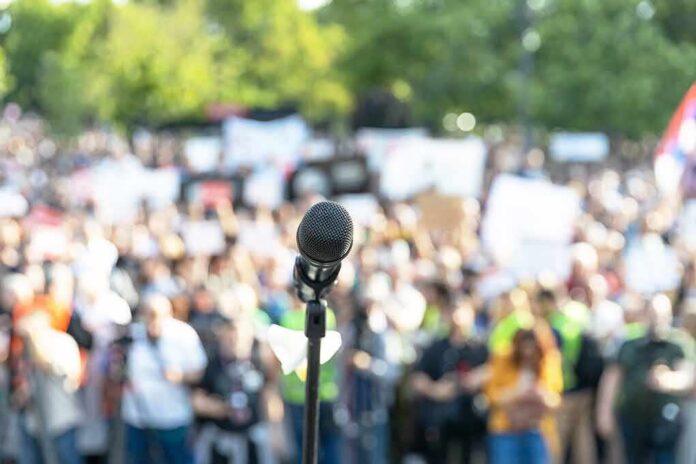
When a global pop star turns a city park into a stage with no tickets, no billboard, and no velvet rope, it reveals something durable about modern celebrity: the most powerful live moments now happen where access is universal and the story writes itself in real time.
At a Glance
- Justin Bieber delivered a surprise, unannounced performance at Los Angeles’ MacArthur Park, drawing onlookers into an impromptu set.
- Local outlets and broadcast clips documented the appearance, showing a low-friction, acoustic-style jam rather than a full-production show.
- The event aligns with a decade-long trend of “pop-up” performances engineered for immediacy, virality, and community proximity.
- Whether fully spontaneous or discreetly planned, park activations of this kind intersect performance, permitting, and publicity — and thrive on the optics of surprise.
What Happened at MacArthur Park
Justin Bieber appeared at MacArthur Park in Los Angeles and performed a brief, intimate set that caught parkgoers off guard. Local coverage described it as a jam session — a stripped-down appearance framed by the language of surprise rather than a conventional tour stop with ticketing and production truss. FOX Los Angeles reported that Bieber was “spotted participating in a jam session at MacArthur Park,” a description consistent with on-the-ground clips that circulated shortly after the set. Spanish-language coverage characterized it as a free, acoustic-style performance in a relaxed, grassy setting — the atmosphere more busker than arena headliner. A national tabloid likewise framed the moment as Bieber “turning up” for an impromptu performance, a tonal through-line that matched viewer-shot video and local TV packages.
Two contextual details matter. First, platforms that normally list or monetize live dates showed no scheduled Bieber concerts around the moment in question, underscoring that this was not a conventional booking or publicized stop on a tour itinerary. Second, broadcast segments located the performance in a park that has been undergoing civic attention — positioning the pop-up as both cultural spectacle and a soft barometer of public-space revitalization, given longstanding efforts to manage safety and access in the area.
How Surprise Park Performances Work
Surprise is a powerful creative device, but in live events it rarely exists in a vacuum. Even the most casual-seeming public performance lives at the intersection of three practical domains: performance practice (what the artist actually does and how minimal the setup can be), permitting and compliance (what the space allows with or without amplification), and publicity strategy (who is meant to see it, and how the moment will travel afterward). Industry playbooks are frank about this: when brands or artists aim for “pop-up” impact, they usually combine lean production with enough pre-work — safety checks, insurance, and space permissions — to minimize risk while preserving the sensation of spontaneity.
None of that subtracts from authenticity; it clarifies the mechanism. Street-level activations succeed when the scene feels discovered rather than delivered, even if a small footprint crew has quietly managed the logistics. In most U.S. cities, truly informal busking without amplification can be legal and unpermitted in many contexts, while amplified sound or crowd control triggers additional requirements; park jurisdictions often maintain their own rules and special-event thresholds. That means the same moment can be experienced as a casual jam by passersby and still reflect thoughtful, light-touch planning behind the curtain — the point is to keep the curtain invisible.
Why This Mode Suits Bieber Now
Bieber’s career has toggled between monumental stages — Grammys, stadium spectacles — and moments of deliberate proximity. The park performance fits a pattern of high-visibility artists rebalancing their live presence with low-friction, high-intimacy appearances that meet fans where they are. Multiple listings and official channels around this period showed no formal tour routing, which further spotlights the show’s out-of-cycle nature and its contrast to large-format festival or televised performances. For an act with an established catalog and a durable social graph, a compact set in a civic space does three things at once: it renews the social contract with casual listeners, gives die-hard fans a folklore-worthy story, and generates video assets that travel farther than most paid placements.
There is also a musical logic here. Accompanied by minimal instrumentation, a pop artist has to let the songs carry more of the load — melodies and hooks, not pyrotechnics. Local language describing the MacArthur Park set emphasized an acoustic feel and a relaxed environment, which maps to the genre’s recurring instinct toward unplugged credibility and away from over-mediated spectacle. It’s the same calculus that makes radio booth performances and living-room sessions continue to punch above their weight.
The Optics of Place: Why MacArthur Park Matters
Location is not a neutral backdrop; it’s part of the message. MacArthur Park has long been shorthand in Los Angeles for contested public space — layered with community life, safety concerns, reinvestment efforts, and a cinematic visual identity. Dropping a mainstream star into that landscape recodes the place, if only for an afternoon, as a civic commons where culture can surface without gates. Local broadcast anchors implicitly tied the appearance to broader renewal narratives, reflecting a recurring media instinct to cast cultural events as indicators of neighborhood trajectory.
That framing isn’t mere boosterism. Public-space performances are particularly sensitive to tone: celebration can slip into spectacle, and spectacle can wear as opportunism if it ignores the community’s realities. The MacArthur Park set, as shown in the clips and descriptions, presented as compact, amiable, and temporary — closer to a neighborly visit than a takeover. In that mode, the artist isn’t colonizing a space; he’s borrowing it for a memory, then handing it back.
Spontaneous vs. Orchestrated: The Useful Distinction
Readers often ask whether a surprise show was “real” — that is, truly spontaneous — or orchestrated. The better question is functional: was the moment designed to feel organic, safe, and shareable? Industry guidance is blunt that the optics of surprise are usually constructed, even when the footprint is small; coordination can range from a courtesy call to a full permit, depending on gear and expected draw. For this appearance, the public-facing evidence sits where these events typically sit: informal vibe, quick setup, and immediate social distribution, with local news arriving as both witness and amplifier. That is the modern template. It works because everyone involved — artist, audience, and city — understands the boundaries, even when they aren’t the headline.
The distinction matters less to fans than the feeling of proximity; the currency is the story they can tell later, ideally with a clip to prove it. For the artist, the reward is cultural momentum that does not depend on an 18-wheeler of production or the months-long inertia of tour routing. And for cities stewarding complex public spaces, a well-behaved micro-event that leaves behind only goodwill is close to ideal.
JUSTIN BIEBER SURPRISES LA PARKGOERS
Justin Bieber stunned onlookers at MacArthur Park in #LosAngeles after showing up for an impromptu performance on Tuesday, turning the public park into an unexpected concert venue.#dailytribune pic.twitter.com/Vn9CXv8B2K
— Daily Tribune (@tribunephl) September 23, 2026
Where This Leaves Live Music
MacArthur Park is not the first park to be briefly remade by a pop star, and it won’t be the last. The format endures because it solves for three pressures at once: the audience’s demand for authenticity, platforms’ appetite for short-form video with narrative punch, and artists’ need to engage between formal cycles without exhausting their teams. Surprise shows have become a reliable instrument in the live-music toolkit — not a novelty, but a calibrated gesture with well-understood mechanics. Bieber’s appearance exemplifies that maturity: light on gear, heavy on story, built to travel.
Sources:
nypost.com, marca.com, foxla.com, seatpick.com, open.spotify.com, lamag.com, shazam.com, ksat.com