

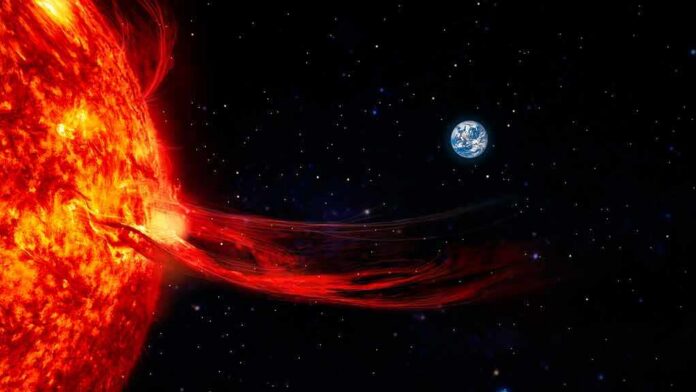
Most solar storms that reach Earth begin not with a dramatic flare but with a quiet filament of magnetized plasma lifting off the Sun; when that filament erupts and drives a coronal mass ejection, a glancing strike is enough to ruffle our magnetic field, push auroras equatorward, and briefly test the engineering margins of power and communications systems.
At a Glance
- A recent filament eruption launched a coronal mass ejection (CME) with a potential glancing impact on Earth, consistent with official forecasts of G1 (Minor) geomagnetic storm conditions.
- Auroras become more likely if the CME’s magnetic field arrives oriented southward; visibility typically expands from the usual auroral oval toward northerly mid-latitudes during G1 events.
- Forecasts hinge on geometry and magnetic orientation; operational centers use heliospheric models and coronagraph data, but arrival time and severity remain probabilistic.
- For most users and infrastructure, a G1 storm is a low-risk, high-interest event; it’s meaningful for power operators, HF/VHF radio users, and satellite controllers, who follow standard mitigations.
What just happened: a filament eruption and a glancing CME
Space-weather forecasters flagged a solar filament eruption near an active region that lofted a substantial cloud of plasma into interplanetary space. The heliospheric modeling and coronagraph observations together supported the expectation of a “glancing blow” at Earth, not a direct hit—a scenario consistent with operational guidance calling for G1 (Minor) geomagnetic storm conditions around the projected arrival window. In that regime, the most visible consequence for most of us is the possibility of aurora slipping farther south than usual, particularly if the CME’s embedded magnetic field couples efficiently with Earth’s magnetosphere upon arrival.
A filament is a long ribbon of relatively cool, dense plasma suspended by magnetic fields above the Sun’s surface. When destabilized—by shear, reconnection, or interaction with nearby magnetic regions—the structure can erupt and carry magnetic flux into the heliosphere as a CME. Coronagraphs such as SOHO/LASCO image these events against the occulted solar disk, allowing analysts to estimate speed, width, and direction, then feed those parameters into models that propagate the ejecta to 1 astronomical unit (Earth’s orbit). A filament-driven CME can look dramatic yet still graze Earth weakly; geometry rules the outcome.
How forecasters turn coronagraph movies into actionable guidance
Operational centers combine human analysis of coronagraph imagery with physics-based models to produce timeline and intensity forecasts. One workhorse is WSA–Enlil, a coupled system that takes a background solar wind solution and injects cone-shaped CME perturbations to simulate arrival times and speed profiles at Earth and other waypoints. The result is an arrival window—often spanning many hours—paired with a probabilistic intensity forecast. Even with good imagery, the model must assume aspects of CME shape and internal field; those assumptions, along with uncertain launch direction and deflection by coronal holes or streamers, drive the error bars that matter to grid operators and satellite controllers.
For the public, translation comes via scale classifications. The NOAA G-scale summarizes likely geomagnetic impacts; G1 corresponds roughly to Kp 5, a level where high-latitude power systems may see weak fluctuations, some high-frequency radio can fade, and auroras step beyond the usual polar confines. In the present case, the forecast language matched a typical filament-CME grazing scenario: G1 conditions were possible over a limited window tied to the CME arrival, with auroral visibility improving for northerly locales if skies cooperated.
Why some CMEs roar and others whisper: geometry, speed, and magnetic orientation
Three variables dominate geoeffectiveness. First, geometry: a CME launched within roughly ±40 degrees of the Sun–Earth line has a better chance of intersecting Earth’s orbit, though even “halo” CMEs can miss if their central axis tilts away or the ejecta deflects en route. Second, kinematics: faster, more massive CMEs carry greater momentum and can compress Earth’s magnetosphere more strongly on arrival. Third—and decisive for storm intensity—is magnetic orientation. When the interplanetary magnetic field (IMF) turns southward (negative Bz), it reconnects more readily with Earth’s northward field, opening the door to energy transfer and auroral activity. Studies show robust correspondence between the source-region field and the Bz observed in interplanetary CMEs, but not with sufficient fidelity to remove uncertainty from any individual event.
That is why official forecasts stay conditional. A clear CME can underperform if its Bz remains northward, and a faint filament launch can surprise to the upside if the orientation is persistently southward. Ensemble forecasting—running many plausible CME configurations through models—narrows the range, but even best-in-class efforts still carry wide timing windows and conditional intensity guidance.
What a G1 storm means in practice: auroras, radio, and grid margins
Minor geomagnetic storms are not “space disaster” material, but they are operationally relevant. For the public, the practical signal is an aurora watch: if you live at high latitudes—or, during stronger intervals of the event, the northern tier of mid-latitudes—get beyond city lights and look north near local midnight. For aviators and mariners relying on HF communications, expect intermittent high-latitude HF degradation; VHF/UHF and SATCOM are generally robust, but polar routes can see brief disruptions. Power grid operators monitor geomagnetically induced currents and often implement routine mitigations; at G1, impacts are usually limited to weak fluctuations on vulnerable long lines at high latitudes.
Satellite operators watch for enhanced drag in low Earth orbit and modify attitude and charging procedures if the solar wind pressure and energetic particle environment rise materially. In a glancing CME, those changes may be modest. The operative point is that minor storms are part of normal space weather; the systems built to operate through them have playbooks and thresholds honed over decades.
Why forecasting filament-driven CMEs remains hard—and what improves it
Filament-associated CMEs challenge forecasters because their launch geometry and internal structure vary widely. Multi-point imaging (SOHO near Earth, plus off-axis perspectives when available) improves 3D reconstructions, but modeling still abstracts complex magnetic flux ropes into simplified shapes. Deflection by coronal holes can redirect a CME off the Sun–Earth line; interaction with preceding or trailing streams can compress or dilute its shock. The literature is candid about these limits: even when an arrival is well predicted, the strongest uncertainties often concern magnetic orientation at 1 AU—the very factor that controls storm strength.
Operationally, the fix is incremental rather than miraculous: better assimilation of coronagraph kinematics into models; real-time solar magnetograms to constrain source-region fields; and upstream monitors at L1 (e.g., DSCOVR) and beyond to give 15–60 minutes of definitive “nowcast” on Bz before the shock front strikes. That tiered approach—probabilistic long-lead, refined day-ahead, and decisive minutes-ahead—is why guidance for a glancing filament CME properly reads as “chance of G1” rather than a deterministic promise.
JUST NOW: an impressive shift in solar wind data has occured, possibly with the arrival of another CME (potentially the fast filament eruption which left the Sun around Sep 14?). Either way, Bz is -10 nT with speeds ripping over 700 km/s. Mid-latitude auroral displays should ramp… pic.twitter.com/UVEf92bXZi
— Vincent Ledvina (@Vincent_Ledvina) September 15, 2026
Bottom line for an interested observer
When a solar filament lifts off and a CME expands asymmetrically, Earth does not need a bull’s-eye hit to notice; a brush by the ejecta’s flank can elevate Kp to the G1 threshold and push auroras into view for northerly mid-latitudes. That is exactly what the current forecast captured: a conditional, time-bounded window for minor geomagnetic storming and improved auroral odds, anchored in coronagraph data and standard heliospheric modeling. Treat it as an invitation rather than a warning—plan a night sky check if you live far north, and trust that the infrastructure you rely on was designed with these routine solar moods in mind.
Sources:
insiderpaper.com, sidc.be, cdaw.gsfc.nasa.gov, eoportal.org, arxiv.org, swsc-journal.org, ar5iv.labs.arxiv.org