

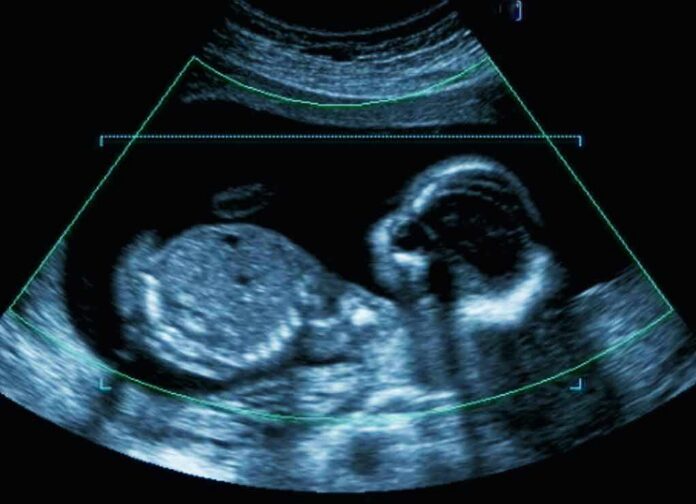
Viral clips of fetuses “smiling” at a parent’s voice feel like proof of emotion before birth; what they reliably show is something just as interesting: a third-trimester brain already wired to detect sound and execute complex, coordinated facial patterns long before true social smiling emerges.
At a Glance
- By the third trimester, fetal hearing functions well enough to detect and react to external voices; paternal and maternal speech can elicit measurable physiological responses.
- Four-dimensional ultrasound frequently captures coordinated fetal facial movements that resemble smiles or laughter; these are developmental motor patterns, not evidence of felt joy.
- A widely shared 32-week ultrasound video aligns with known physiology of late-gestation auditory responsiveness, but it does not prove the voice caused a genuine emotional smile.
- Interpreting these moments requires two lenses at once: real sensory engagement in utero and the difference between reflexive/practice expressions and postnatal social emotion.
What third-trimester fetuses can actually do with sound
By the final trimester, the fetal auditory system is open for business. Sound—filtered through amniotic fluid and maternal tissue—arrives muffled but structured; pitch contours, rhythm, and intensity still matter. In controlled studies, fetuses exhibit physiological changes when exposed to recorded parental voices, including sustained heart-rate increases across the stimulus window, a signal that the brainstem and higher autonomic circuits are detecting and processing vocal input. Clinically oriented summaries aimed at parents echo this baseline: hearing is considered intact late in pregnancy and fetuses can orient or modulate activity in response to external sound. This is why newborns arrive pre-tuned to human speech prosody and why repeated voices from pregnancy often feel familiar after birth. The capacity is real; it is not folklore.
From that foundation, the leap to “recognition” or “bonding” is where popular narratives get ahead of the data. Responsiveness does not, by itself, settle questions about subjective experience; a heart-rate shift is the nervous system’s signature of detection, not an index of emotion. The same caution applies to any single movement caught on a scan: timing can be suggestive, but causation requires repeated, controlled presentation and blinded interpretation—conditions a happy clinic moment rarely meets.
Why fetuses look like they’re smiling on 4D ultrasound
High-frame-rate, 3D/4D sonography has revolutionized our view of prenatal behavior. What once read as random twitches now resolves into organized facial “gestalts”—coordinated muscle sequences that map to recognizable expressions, including those that resemble smiles and laughter. The developmental point is practice, not performance. Peer-reviewed work has documented these composite patterns in healthy pregnancies, showing how disparate muscle groups begin to fire in the correct order as neural circuits myelinate and synchronize across the second and third trimesters. The fetus is rehearsing the motor choreography it will need after birth to breathe, feed, cry, and, in time, communicate.
That rehearsal extends to the mouth and zygomatic muscles that, to adult eyes, read as a grin. But interpretation matters. Before birth—and for weeks after—most smiles are reflexive or state-dependent (especially during active/REM-like sleep), not social. Social smiling, the reciprocal expression directed at a caregiver’s face, typically stabilizes around 6 to 8 weeks postnatal. In utero, a “smile” is best understood as a normal motor program assembling on schedule; it can be modulated by arousal and sensory input, yet it does not imply a felt emotion like joy.
The 32-week “smile at dad’s voice” clip: what it supports—and what it doesn’t
In the widely circulated 32-week video, the fetus appears to form a grin as the father speaks near the probe; news coverage and social posts present it as a daughter “smiling” at his voice, with consistent details about gestational age and the clinical setting. That narrative comports with two facts: late-gestation hearing supports responsiveness to voice, and fetuses at that age display coordinated facial expressions that resemble smiling. Taken together, it is entirely plausible that the fetus heard the voice and that a facial movement followed. But plausibility is not proof of cause or of emotion. Absent unedited scan footage with on-channel audio, repeated trials, and blinded review, the strongest reading is the modest one: a timely, charming co-occurrence consistent with known physiology, not definitive evidence of a social smile triggered by paternal speech.
Research specifically comparing responses to maternal versus paternal voices reinforces this nuance. Late-gestation fetuses register both, as evidenced by heart-rate change, while newborns often prefer the mother’s voice—likely reflecting constant in utero exposure to her timbre conducted through bone and tissue. The paternal voice still “lands,” particularly if it has been repeatedly present during pregnancy, but the literature does not claim that a single utterance elicits an emotional grin.
How auditory responsiveness and facial rehearsal intersect
Two developmental systems—sensory processing and motor patterning—are maturing in parallel at 32 weeks. Auditory input can shift fetal state: slight arousal, altered breathing movements, or subtle heart-rate changes. Motor programs for the face are becoming more coordinated and more frequent on scans as neural connectivity matures. When a voice arrives at the right moment, you can observe a plausible chain: stimulus, state modulation, and a pre-assembled facial sequence expressing itself as a “smile.” That linkage is mechanistically sensible. What it does not do is adjudicate inner experience. The right conclusion is therefore layered: the fetus is listening; the face is practicing; the timing can align; the meaning remains motor, not emotional.
How clinicians and researchers would verify causation
If you wanted to move beyond a delightful anecdote to an evidence-backed claim that paternal speech specifically triggers a smile, the protocol is straightforward in concept and exacting in practice. You would capture continuous, unedited 4D ultrasound with synchronized audio, present randomized on/off voice blocks at matched intensities, and have independent raters—blinded to stimulus timing—code facial movements frame by frame. You would quantify the onset latency distribution, repeat across sessions to address chance alignment, and analyze whether “smile” sequences cluster significantly after stimulus onset compared with baseline. Some voice studies already apply analogous rigor using heart-rate as the response variable; extending that structure to facial coding would bring the same clarity to expression claims.
Short of that, clinicians will continue to advise parents to speak, sing, and read near the belly—advice supported by the robust evidence that repeated, gentle exposure to speech rhythms helps familiarize the fetus with voices it will hear constantly after birth. That guidance is about shaping a sensory environment, not proving that in utero smiles are social or emotional.
Baby smiles hearing Dad’s voice
Pre birth interactions help strengthen the bond between mom’s and dad’s with their baby. It’s touching to see the genuine love the father has for his unborn child. All children need to have unconditional love from both parents. Each parent brings…
— Patricia 🇺🇸 (@1109Patricia) July 31, 2026
How to watch these videos with both wonder and discipline
There is no need to drain the magic from moments like the 32-week clip to keep our claims honest. The wonder is real: a fetus hears; a face rehearses; a family witnesses an exquisitely timed expression on the screen. The discipline is equally important: don’t convert responsiveness into “recognition,” rehearsal into “emotion,” or coincidence into “causation” without the kind of repeated, controlled evidence that science demands. Hold both thoughts, and the story becomes richer. You get to keep the charm of the image and gain a deeper appreciation for the developmental machinery that produced it.
Sources:
instagram.com, lozierinstitute.org, adatewithbaby.com