

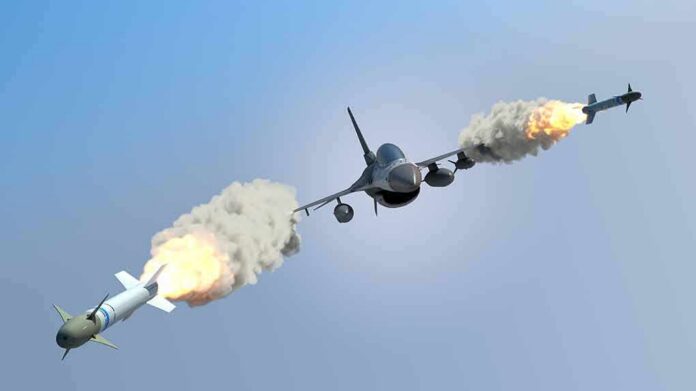
In the middle of a fragile ceasefire and stalled negotiations, the latest U.S. strikes on Iran are best understood not as a sudden outburst, but as a deliberate, large-scale use of force that Washington openly framed as retaliation and self‑defense after Iranian attacks on U.S. forces and international shipping.
At a Glance
- U.S. Central Command says American forces struck more than 80 Iranian military targets, focusing on air defenses, command centers, coastal radar, anti‑ship missile sites, and IRGC small boats.
- The strikes were publicly described as self‑defense and retaliation for Iranian attacks on U.S. bases in Jordan and on commercial vessels transiting the Strait of Hormuz.
- President Trump had warned Iran of a “hard” response; within hours, CENTCOM launched what it called a “powerful” wave of strikes.
- The operation fits a broader pattern in the war: localized trigger events are used to justify wider campaigns aimed at degrading Iran’s maritime, missile, and drone capabilities.
- While the occurrence of Iranian attacks and U.S. strikes is well documented, much of the detailed forensic and legal reasoning remains classified, limiting outside scrutiny.
The Trigger: Iranian Attacks on U.S. Forces and Shipping
According to U.S. Central Command and convergent wire service reporting, the immediate trigger for the latest wave of strikes was a set of Iranian attacks on U.S. forces and international commerce, centered on U.S. positions in Jordan and shipping routes near the Strait of Hormuz. CENTCOM has stated that Iranian forces, including units of the Islamic Revolutionary Guard Corps (IRGC), launched missiles and drones at American bases in Jordan, killing or threatening U.S. service members and attempting to disrupt regional air operations. In parallel, U.S. statements describe Iranian use of small boats, coastal radar, and anti‑ship systems to harass or attack commercial vessels transiting the strait, a chokepoint through which a significant share of global oil and gas exports move.
Jordanian military communiqués reported intercepting multiple ballistic missiles fired from Iran toward Jordanian territory, corroborating part of the U.S. account of an Iranian strike package aimed at bases hosting American troops. Independent reporting from Reuters, the Associated Press, and regional broadcasters adds detail on casualties: at least two U.S. personnel were confirmed killed in earlier attacks, with additional troops injured or briefly missing during the sequence of strikes on Muwaffaq Salti Air Base and related facilities. These incidents formed the operational and political backdrop against which President Trump and his national‑security team framed the response.
The Strikes: Target Sets and Operational Design
CENTCOM’s public release describes a highly coordinated strike package directed against more than 80 Iranian military targets in and around the Strait of Hormuz, executed with precision munitions from U.S. Air Force and Navy platforms. The target list, as outlined by CENTCOM and echoed in wire service summaries, centers on several categories of capability: integrated air‑defense systems, command‑and‑control networks, coastal radar installations, anti‑ship missile sites, and over 60 IRGC small boats assessed as part of Iran’s maritime harassment toolkit.
Additional rounds of strikes across multiple nights hit missile and drone storage facilities, ground‑control stations, surveillance and communications nodes, and logistics infrastructure that connect these systems to operational commanders. In some cases U.S. forces also struck bridges and other dual‑use infrastructure when it was assessed to have a direct role in sustaining Iranian military operations, particularly those supporting IRGC deployments near the strait and along key coastal corridors. Taken together, this represents not a single, discrete raid, but a continuing campaign of “self‑defense strikes” with a clear degradative intent: to reduce Iran’s practical capacity to threaten U.S. forces and commercial shipping, rather than merely to signal displeasure.
CENTCOM has emphasized the precision character of the operations, noting that the strikes were designed to minimize collateral damage while still achieving significant effects on Iranian military assets. Nonetheless, Iranian state media and some international outlets have reported civilian harm, including damage to residential structures and casualties on Qeshm Island and in other coastal areas; those claims sit alongside the official U.S. narrative and speak to the inevitable human cost of airpower employed in densely populated regions.
Washington’s Rationale: Self‑Defense and Protection of Commerce
In formal statements and media briefings, U.S. officials have consistently framed these strikes as grounded in the logic of self‑defense. CENTCOM’s public language stresses that the operations were “immediate responses” to Iranian attacks on U.S. forces and on international shipping, undertaken to “degrade Iran’s ability” to continue such actions. That framing aligns with the broader pattern in modern air warfare in which governments invoke self‑defense and retaliation as the primary legal and political justification for early strike packages, especially when they follow attacks on troops stationed abroad.
There is a second layer to the U.S. rationale: protection of civilian mariners and commercial vessels. CENTCOM explicitly tied the target selection to threats against shipping in the Strait of Hormuz, an international trade corridor vital to global energy flows. By striking coastal radar, anti‑ship missile launchers, and fleets of IRGC small boats, U.S. planners sought to reduce Iran’s capacity to threaten tankers and cargo ships, a mission that resonates with longstanding U.S. commitments to freedom of navigation and the security of sea lines of communication. In public messaging, this broader justification is important because it situates the strikes not just as revenge for attacks in Jordan, but as a protective measure for third‑country ships and crews traversing the strait.
President Trump’s own statements preceding and surrounding the strikes complement this official rationale with more blunt political language. He warned that Iran would “get a beating” and described the U.S. response as hitting Iran “very hard,” with little it could do to prevent the blows. At the same time, he linked the use of force to stalled negotiations and Iran’s behavior at the bargaining table, underscoring that military pressure and diplomatic engagement were being pursued in parallel rather than as mutually exclusive tracks.
Timing, Diplomacy, and the Ceasefire Context
The strikes did not occur in a vacuum. They were launched against the backdrop of an uneasy ceasefire established through a memorandum of understanding between the United States and Iran, with mediators such as Pakistan and Qatar shuttling proposals aimed at extending the truce and opening a more durable negotiation over Iran’s nuclear program and regional activities. Vice President JD Vance and other senior officials had spoken publicly of “good progress” toward a follow‑on deal that would expand the ceasefire by sixty days and begin technical talks on enrichment and missile constraints.
Against that diplomatic framework, the attacks on U.S. forces in Jordan and on shipping were characterized by Washington as violations of the ceasefire, and by Tehran as responses to earlier U.S. actions and sanctions pressure. President Trump declared the truce “over” from his perspective, even as he acknowledged that indirect talks continued through mediators. CENTCOM’s description of the strikes as “self‑defense” rather than purely offensive operations was calibrated to preserve the claim that the United States remained, at least formally, committed to a negotiated end to the war while reserving the right to defend its personnel and economic interests.
This dual posture—armed retaliation on one hand, ongoing technical talks on the other—is a hallmark of the U.S.–Iran confrontation during this period. Negotiations over a memorandum of understanding and nuclear issues proceeded in fits and starts, with Iranian officials publicly downplaying optimism and insisting they were merely reviewing U.S. proposals. Meanwhile, U.S. forces conducted repeated strike cycles whenever Iranian actions crossed what Washington defined as red lines, especially in the Strait of Hormuz and around bases in Jordan and Iraq.
Mechanics of Modern Retaliation: How Trigger Events Become Campaigns
Strategically, the sequence from Iranian attacks to American strikes illustrates how contemporary militaries translate localized trigger events into broader operational campaigns. An incident such as a missile or drone strike on a base in Jordan is first assessed through intelligence channels and advisory bodies; commanders then identify the specific Iranian systems and units believed to be responsible or enabling the attack. From there, targeteers build a package that does two things: responds directly to the trigger by hitting associated assets, and shapes the theater by degrading other capabilities that could sustain similar attacks in the near future.
In this case, U.S. targeting went beyond the immediate launch sites for missiles and drones and expanded to air defenses, surveillance networks, and maritime platforms across southern Iran and the Strait. That broader set of targets has the effect of limiting Iran’s options for escalation and impeding its ability to threaten shipping and bases even if it chooses to continue hostilities. It also sends a message to Iranian leadership that attacks on U.S. forces will carry costs not just at the point of contact but across multiple domains of their military architecture.
For outside observers, however, this dynamic makes it harder to draw a one‑to‑one line between the initial incident and every subsequent strike. Public records typically document that the strikes happened and what governments said about them, but the underlying intelligence assessments, proportionality analysis, and chain‑of‑command authorizations are almost always classified. As a result, analysts can confidently describe the scale and focus of the U.S. campaign, yet have less visibility into the internal legal reasoning linking each target to the Jordan attacks or the maritime incidents.
Information Gaps and the Limits of Public Scrutiny
On the central facts, the record is clear and largely uncontested: Iranian forces launched missiles and drones toward U.S. bases in Jordan and threatened shipping near the Strait of Hormuz; U.S. forces responded by striking dozens of Iranian military targets that support air, missile, drone, and maritime operations; and Washington publicly framed these actions as self‑defense and retaliation. Where uncertainty remains is in the granular evidentiary chain tying specific Iranian units and orders to each attack, and in the detailed legal analysis of proportionality and necessity.
The open record in this episode is dominated by official U.S. statements and major media reporting that echo those statements. It does not yet include declassified CENTCOM operational orders, target nomination packets, or intelligence intercepts that would allow outsiders to fully audit the retaliation narrative. Nor does it offer a comprehensive, public Jordanian technical report on missile trajectories, debris, and base damage beyond brief military statements of interception and casualties. This asymmetry is characteristic of wartime reporting: during rapid escalation, states reveal enough information to justify their actions politically, but they rarely expose the full evidentiary foundation behind operational decisions while the conflict is ongoing.
For thoughtful observers, the implication is not that the core narrative is false, but that its verification rests on a mix of trust in institutional processes and cautious skepticism about the completeness of what is shared. The documented harm to U.S. personnel and the specificity of the Iranian capabilities targeted support the U.S. account of serious Iranian aggression and a deliberate effort to degrade it. At the same time, serious questions about proportionality, civilian risk, and the long‑term strategic wisdom of episodic air campaigns in lieu of a settled diplomatic framework will only be answerable when more of the underlying record is eventually opened.
Why This Episode Matters Going Forward
For a reader tracking the broader arc of U.S.–Iran relations, this round of strikes is significant for several reasons. It confirms that, even in the context of ceasefire memoranda and ongoing negotiations, both sides remain willing to use substantial force in response to perceived violations or provocations. It shows how quickly a single attack on a base in Jordan or a cluster of incidents in the Strait of Hormuz can cascade into multi‑night campaigns that strike deep into Iranian territory and risk civilian casualties.
It also underscores the centrality of maritime security and regional bases to the U.S. conception of vital interests in the Middle East. When those interests are challenged—by missiles fired at housing units for American troops, or by IRGC boats and shore batteries menacing tankers—the response is not limited to defensive measures at the point of attack. Instead, the U.S. military seeks to reshape the operating environment by disabling the adversary’s ability to repeat such actions, even at the cost of further escalation.
Finally, this episode highlights the enduring tension between the imperatives of wartime secrecy and the public’s desire for transparent accountability. Citizens and allies can observe that retaliation occurred and infer its strategic logic, but they are largely excluded from the classified assessments that would confirm whether every strike was strictly necessary, proportionate, and wisely chosen. In an era when conflicts increasingly play out under the gaze of global media and social platforms, that gap between what is known and what is knowable will remain a central challenge in evaluating the use of force—particularly in complex theaters like the U.S.–Iran confrontation over Jordan and the Strait of Hormuz.
Sources:
facebook.com, centcom.mil, reuters.com, cnn.com, bbc.com, npr.org, aljazeera.com, youtube.com, cbsnews.com, wkyufm.org, thehill.com, abc7ny.com