

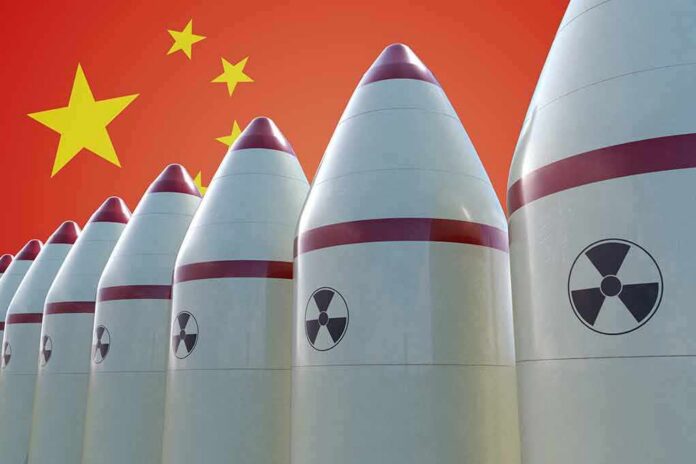
China’s DF-17 hypersonic missile, now operational, can outrun and outmaneuver U.S. defenses across the Western Pacific.
Story Highlights
- Think tank and Pentagon reporting say the DF-17 is deployed and operational.
- U.S. intelligence estimates the DF-17 range at roughly 1,800–2,500 kilometers.
- Recent state media footage showcased road-mobile launch and rapid relocation claims.
- Hypersonic glide flight cuts warning time and complicates tracking, raising risk.
What China Just Showed And Why It Matters
Chinese state television aired rare DF-17 launch footage that highlighted road-mobile operations and fast launch setup. Official and aligned outlets said the launcher could relocate even after advanced preparations and still fire, a tactic meant to keep U.S. forces guessing and to survive a first strike. These clips followed years of parades and hints. This time, the message targeted the Pacific: watch the truck, not a fixed pad. Mobility makes finding and stopping the system much harder.
The Center for Strategic and International Studies describes the DF-17 as a Chinese medium-range missile carrying a hypersonic glide vehicle. It says U.S. intelligence estimates its range between 1,800 and 2,500 kilometers, which reaches across the first island chain and key U.S. hubs. The China missile inventory page at the same project lists the DF-17 as operational, reinforcing that this is not a lab toy but a fielded weapon in regular units. That status shifts daily planning for U.S. commanders.
What Hypersonic Glide Means For U.S. Forces
The United States Department of Defense has assessed that China deployed the DF-17 around 2020, and analysts believe it could carry conventional or, potentially, nuclear warheads. A glide vehicle flies lower and can maneuver more than a classic ballistic arc. That makes tracking tougher and cuts reaction time. Research summarized in security briefs and congressional analysis shows hypersonic flight can halve detection windows and stress missile defense networks. Shorter warning time compresses decisions for U.S. and allied forces.
These factors matter in the Western Pacific, where distance is tight and bases are known. With a range near 2,000 kilometers, the DF-17 can threaten ports, airfields, fuel farms, and ships spread across Japan, Taiwan’s vicinity, and the Philippines. China-linked coverage has also framed the DF-17 as part of a broader anti-access strategy aimed at pushing U.S. carriers and surveillance aircraft farther from the fight. Whether every claim proves out or not, the core outcome is clear: U.S. units must disperse, harden, and move faster.
Sorting Signal From Hype
Chinese state messaging loves a show. But independent tracking and reputable assessments align on key facts: the DF-17 exists, it is operational, and it complicates interception. The Center for Strategic and International Studies entries and Pentagon-linked reporting converge on those points. State media’s claim that launchers can relocate during prep cannot be verified in open sources, so treat that as a tactic they want us to see, not proven doctrine. Still, the road-mobile concept itself is well established and credible.
🇨🇳🚀🇺🇸 No more safe zone for US AWACS: China pushes the air battle deep into the rear
According to Bloomberg, China has developed hypersonic glide vehicles that can launch air-to-air weapons in flight, a combination not publicly known elsewhere. Their intended targets include… pic.twitter.com/K9XgU70GFZ
— brane mijatovic (@brane_mija64426) August 25, 2026
For Americans who value peace through strength, the takeaway is plain. Deterrence depends on speed, resilience, and real capacity. President Trump’s team must keep funding rapid sensors, layered defenses, long-range strike, and hardened Pacific posture. Congress should cut red tape that slows test ranges and production lines. Allies need to share more munitions stocks and base access. China is working to shrink our warning time. We must widen theirs, and keep every base, ship, and aircrew in the fight.
Sources:
feedpress.me, missilethreat.csis.org, youtube.com, warriormaven.com, defensemirror.com, newsweek.com