

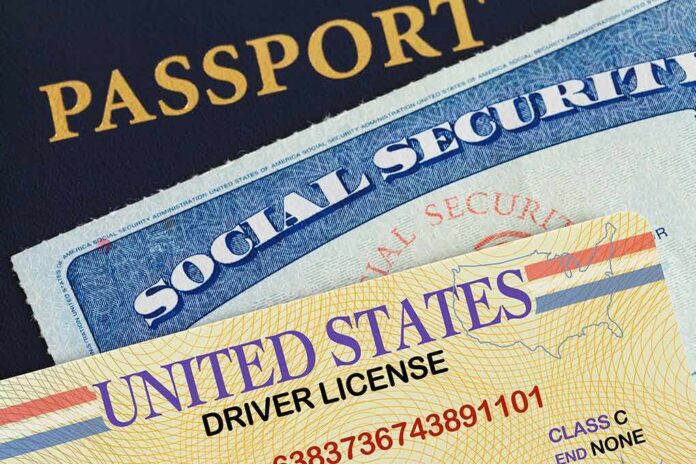
When a single driver can cycle through names, dates of birth, and states to collect licenses—including a commercial driver’s license—then kill a family on an interstate, the failure is not abstract. It is the intersection of identity fraud and licensing policy, and it is fixable if we treat verification as a core public-safety function rather than a paperwork chore.
The Short Version
- Ohio investigators say the semitruck driver in a fatal I-71 crash used multiple identities to secure government IDs, including an Ohio CDL years earlier.
- Sen. Bernie Moreno has asked federal agencies to investigate how state and federal screens missed the fraud and whether immigration and licensing actions should be unwound.
- Connecticut’s “drive-only” license program is lawful and limited, but prior audits and revocations show document fraud risk is real and recurring.
- Robust identity-proofing—especially address and identity verification for applicants using foreign documents—remains the decisive safety control, not the political label on a license.
What is established in the Ohio case
According to Ohio authorities cited by Sen. Bernie Moreno, the truck driver charged in a fiery I-71 crash that killed three members of an Ohio family had long operated under a web of false identities. Investigators reported the use of multiple names and dates of birth to obtain state and federal identification, including an Ohio driver’s license around 2003 and a commercial driver’s license in 2007 under an alternate identity. Moreno’s letter to the Departments of Transportation and Homeland Security asks for a comprehensive probe of how those credentials were issued and whether naturalization or other federal actions were obtained through the same fraud vector. A local Ohio outlet summarized the same investigative findings: entry to the U.S. in the 1990s, followed by identity switching to secure credentials across systems, then referral of the current case to immigration authorities after the crash.
On its face, this is not a one-off paperwork error; it is sustained identity manipulation across agencies and years. Commercial licensure adds stakes. A CDL is not a routine credential; it confers the right to operate up to 80,000-pound vehicles in mixed traffic, and its issuance presumes a verified identity, a clean eligibility profile, and training history traceable to a real person. When any of that sits atop a synthetic or stolen identity, downstream accountability—citations, suspensions, crash history—detaches from the actor behind the wheel.
How Connecticut’s “drive-only” regime actually works
Moreno’s challenge to Connecticut’s governor spotlights a common conflation: permissive licensing for undocumented residents versus weak verification. Connecticut’s 2013 law directs the DMV to issue “for driving purposes only” licenses to residents who cannot prove lawful U.S. presence or provide a Social Security number. By statute and guidance, these credentials do not function as REAL ID, do not confer broader federal identity privileges, and require proof of identity and Connecticut residence to be issued. The state is explicit that applicants are ineligible if they have committed identity fraud at the DMV; prior fraudulent licenses trigger suspension pathways and review by the Document Integrity Unit before any new application proceeds. Separately, Connecticut law voids any state-issued license ab initio if it is obtained through a material false statement of personal identifying information, and it provides penalties for misrepresentation or impersonation.
Those are the rules on paper. Enforcement capacity is the question in practice. Years into the program, an NBC Connecticut investigation reported the DMV had flagged “numerous” drive-only licenses tied to fake proof-of-address submissions and revoked at least 87 such licenses—evidence both that fraud attempts occur and that targeted audits can catch them post-issuance. None of that makes a direct causal bridge to the Ohio crash; it does demonstrate that address and identity-document fraud are predictable attack surfaces wherever foreign documents and nonstandard proof chains are accepted.
The real safety control is identity-proofing, not the label on the license
States created undocumented licensing regimes for familiar reasons: to move unlicensed drivers into tested, insured status, and to align risk with training and accountability. The empirical literature is mixed but instructive. Peer-reviewed work on California’s program found no increase in total or fatal crashes after implementation and a measurable drop in hit-and-run incidents—fewer drivers fleeing because they could lawfully stop and be identified. Other research has associated licensing access with higher insurance coverage and modest changes in safety metrics, though findings are not uniform across states or time. A newer study tied licensing access to a rise in fatal crashes in certain contexts, highlighting that effects can vary with demographics and enforcement baselines. These results argue for design rigor, not blanket repeal: programs succeed or fail on the integrity of their issuance procedures and ongoing audits.
Identity-proofing is where systems most often stumble. Large-scale DMV data sweeps have uncovered deceased, duplicate, and synthetic identities lurking in motor-vehicle files—tens of thousands of records in a single state review—because legacy systems historically trusted submissions that should have been algorithmically or procedurally challenged. That is why well-regarded policy guidance urges DMVs to work with foreign consulates, community organizations, and identity experts to validate commonly presented documents, and to engineer processes that anticipate fraud vectors specific to non-SSN applicants—especially proof-of-residency documents that are easy to fabricate or borrow.
Where accountability should focus in interstate cases
The Ohio crash raises a separate, essential point: commercial licensing and interstate motor-carrier operations are only as strong as the weakest identity checkpoint in the chain. If an individual can secure a base-state driver’s license using a stolen or synthetic identity, then acquire a CDL, then present a clean motor-vehicle record that belongs to the victim of identity theft rather than the driver, every subsequent control—employer vetting, insurance underwriting, roadside enforcement—operates on bad inputs. Moreno’s call for a joint DOT–DHS investigation is correctly aimed at the seams: state issuance practices, federal verification services used (or not used) at the time, and the portability of false identities across jurisdictions.
Connecticut is part of that seam not because “drive-only” licenses cause crashes, but because any program that accepts alternative documentation must compensate with stronger fraud analytics and post-issuance monitoring. The fact that Connecticut has a dedicated Document Integrity Unit and a history of revocations shows the state understands the risk; the policy question is whether its tools—document authentication, data-matching with death records and incarceration files, probabilistic address analytics, and rapid interdiction—are commensurate with the adversary tactics seen in the Ohio case.
What would a credible fix look like
First, make identity resolution a safety-critical function for commercial licensing. Treat CDL issuance like a security clearance for identity: mandatory multi-source verification, checks against national death and incarceration databases, and real-time fraud analytics tuned to detect recycled addresses, mail drops, and document patterns common in synthetic IDs. Second, tighten proof-of-residency acceptance. Utility bills and consumer-finance statements are routinely forged; states should favor data streams with higher provenance (e.g., verified employer payroll, verified school enrollment, tax records) and use automated cross-checks rather than visual inspection alone.
Third, institutionalize post-issuance audits. Fraud often emerges after issuance through collisions in data—two licenses sharing biometrics, divergent dates of birth tied to the same address, or a licensee traced to a Social Security number later reported stolen. Scheduled sweeps, coupled with prompt suspension under statutes that void fraudulently obtained licenses, close the window of risk. Fourth, align state practice with federal services. Where lawful, route identity checks through federal verification tools for CDL applicants and motor-carrier personnel files, and require carriers to certify enrollment in identity-compliance programs as a condition of intrastate and interstate operations.
The bottom line
The Ohio tragedy does not prove that licensing undocumented residents is inherently unsafe; it proves that allowing anyone—citizen or not—to assemble a driving identity from false parts defeats the entire regulatory architecture. Connecticut’s legal framework contains the right concepts: limited-purpose licenses, explicit ineligibility for DMV identity fraud, and authority to void credentials obtained by misrepresentation. The question policymakers must answer, in Connecticut and elsewhere, is whether their verification and audit muscle matches the ingenuity of those who will try to game it. Public safety depends on that answer far more than on the political shorthand we use for a piece of plastic.
Sources:
townhall.com, moreno.senate.gov, foxnews.com, law.justia.com, cslib.contentdm.oclc.org, whio.com, justice.gov, nbcconnecticut.com, portal.ct.gov, ohioattorneygeneral.gov