
When a political boycott names neighborhood restaurants and schedules a march past their doors, it stops being an abstract debate about free speech and becomes a stress test of how a city draws the line between protected protest and discriminatory targeting—especially when the rhetoric and timing evoke a history of anti-Jewish violence.
At a Glance
- Organizers framed the Philadelphia action as an anti-Zionist boycott of specific businesses based on owners’ alleged support for Israel, not a blanket call against Jewish commerce.
- Officials and major Jewish organizations condemned the event as antisemitic, citing flyer language (“no business for Zionists”) and its eve-of-Kristallnacht timing.
- Street dynamics mixed protest, counterprotest, and police management; at least one report documented arrests during the confrontations.
- As with many consumer boycotts, the immediate “effectiveness” question is murky; visible countermobilization blunted the effort in the short term.
What actually happened and why it drew such a fierce response
The organizers—a self-described anti-fascist, anti-Zionist cycling collective—announced a boycott ride that would visit six named Philadelphia restaurants. Their stated rationale: the owners had expressed support for Israel or donated to Israel-related causes; one owner, for example, told the Philadelphia Inquirer he believed he was targeted after raising several thousand dollars for traumatized Israeli children after the Oct. 7, 2023 attack. The protest method—public shaming combined with consumer pressure—is a familiar template in U.S. political life. But the action’s reception turned on two choices: the language on promotional materials and the date set for the ride.
First, officials and numerous outlets highlighted the flyer’s phrasing—“no business for Zionists” and “these Zionist establishments must go”—as signaling exclusionary intent. The Pennsylvania Human Relations Commission explicitly cited those phrases in condemning the plan, aligning the language with targeting a protected community rather than a policy position. Second, the ride was slated for the eve of Kristallnacht’s anniversary, the 1938 Nazi pogrom that destroyed thousands of Jewish businesses and synagogues—the historical parallel many residents needed no help to see. Philadelphia’s mayor put the city’s stance succinctly: protest is protected, she said, but singling out businesses because their owners are Jewish is unacceptable.
Boycott as protected speech versus discriminatory conduct
American law has long protected political boycotts as expressive conduct; the tactic sits in the same family as picketing and petitioning, even if the target is economic rather than electoral. That protection, however, does not immunize how a boycott is framed or whom it targets. When a call to withhold commerce tracks a religious or ethnoreligious identity—by words, timing, or selection pattern—it invites legal and civic condemnation. That is why the fight in Philadelphia hinged less on the abstract legitimacy of boycotts and more on whether this specific action crossed into singling out Jews.
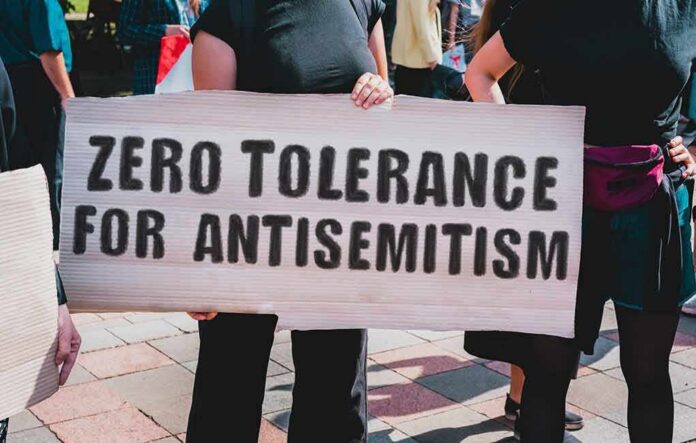
Organizers said they opposed antisemitism and aimed at owners’ political activity. But critics argued the selection—Israeli or Jewish-identified eateries, a Jewish deli, and kosher-style shops—mapped too neatly onto Jewish identity, and that the timing made the intent inescapable. The mayor’s statement and statewide messaging from Jewish organizations framed the event as discriminatory and urged residents to answer with visible patronage of the targeted businesses. That response materialized on the ground: coverage described large counterprotest crowds with Israeli flags and signs condemning antisemitism, turning sidewalks into lines of support that blunted the boycott’s spirit of isolation.
Street-level mechanics: protest, counterprotest, policing
In practice, these events run on choreography. The cyclists and allied protesters publicized a route and target list; counterprotesters moved to the same storefronts. Police staged to keep groups separated and traffic moving. Accounts diverge on how uniformly peaceful the day stayed, which is common when multiple scenes unfold simultaneously: some windows of time saw no physical altercations; another report documented at least one arrest early in the day and later three arrests linked to scuffles, including one for assault on an officer, with two officers injured but not requiring treatment. The presence of police lines, flags, and dueling chants gave the city a familiar tableau of polarized street politics, but without the property damage that often reframes a protest’s meaning in hindsight.
Effectiveness: what the research says and what the sidewalks showed
Consumer boycotts can move markets, but not always in the way organizers intend—or on the timeline they imagine. A multi-decade review of 125 U.S. boycotts found statistically significant negative effects on targeted firms’ shareholder wealth following boycott calls, indicating that coordinated consumer pressure can impose real costs even absent immediate concessions. That does not mean any particular neighborhood action will achieve its goals. In Philadelphia, the observable first-order effect was a countermobilization: long lines of supportive patrons and highly public official condemnation made the boycott look isolated rather than ascendant in its early phase. Whether the targeted businesses saw a sustained revenue effect is a separate, longer-term question the street theater alone cannot answer.
Where the genuine disagreement lies
The core dispute is definitional and evidentiary. Organizers say they targeted political behavior—donations or statements in support of Israel—and not Jewish identity. Their critics argue the selection pattern, rhetoric, and Kristallnacht-eve timing transformed a political protest into antisemitic targeting. The evidentiary gap is nontrivial: available reporting relays the organizers’ rationale but does not furnish a complete ledger of the specific donations or institutional actions by every business on the list. Conversely, the flyer language and date are documented, and officials have anchored their condemnation to those specifics; the Pennsylvania Human Relations Commission memorialized the phrases and disapproved the campaign accordingly. In short: the organizers offer intent; the opponents point to artifacts.
Jewish-owned businesses were targeted in a bicycle boycott ride in Philadelphia Sunday. The demonstration, organized by Philly Bike On Your Left, a self-described anti-Zionist group, was met with counter protesters who came out to support the businesses.
The boycott targeted six… pic.twitter.com/XSDjJWPbt4
— Mosheh Oinounou (@Mosheh) November 9, 2026
How future campaigns will be judged
Three practical lessons emerge. First, words and dates are not cosmetic. Rhetoric that collapses “Zionist establishments” into a category of people, paired with a Kristallnacht anniversary, will override any subsequent clarification about policy-focused intent. Second, if the claim is that specific owners channeled money or legitimacy to contested causes, transparency is the only antidote to ambiguity: document the donations, corporate statements, or institutional affiliations with the same rigor one would demand of a newsroom. Third, anticipate the counterswing. In a plural city, boycotts that touch community identity—Jewish, Muslim, Arab, Israeli, Palestinian—will reliably trigger not only condemnation from officials but a tactical “buycott” that transforms your target list into a queue.
Why this matters beyond Philadelphia
As Middle East politics continue to surface in American civic life, the boundary between legitimate, even sharp, criticism of a state and discrimination against a people will define the social license of protest. Boycotts remain a protected and potent instrument of persuasion. They also demand discipline—of language, evidence, and timing—precisely because they operate in the intimate realm of daily commerce. Cross that boundary, and you do not merely lose the argument; you recruit your opposition, fill their sidewalks, and, as Philadelphia showed, hand them the momentum you came to disrupt.
Sources:
foxnews.com, nbcphiladelphia.com, wdsu.com, whyy.org, edition.cnn.com, cnn.com, abc17news.com, theatlantic.com