
When a school bus carrying visually impaired students leaves the roadway and slams into a neighborhood pharmacy, the real story is not only that everyone survived with minor injuries, but how a multi-vehicle chain of events, emergency response, and long-standing safety concerns all converged in a single afternoon.
Key Points
- A Baltimore County school bus transporting Maryland School for the Blind students crashed into a Parkville pharmacy after another car veered into its lane, according to police.
- The bus driver, one child on the bus, and an adult who was not on the bus were hospitalized with minor injuries; at least eight others were evaluated at the scene and declined transport.
- The collision involved three vehicles and triggered a mass-casualty-style response, but there were no fatalities and no reports of life-threatening injuries.
- The Maryland School for the Blind and county officials emphasize that the cause is still under investigation, even as residents raise broader concerns about traffic safety on Harford Road.
What Happened in Parkville
On a rainy weekday afternoon in Parkville, a county-contracted school bus transporting students from the Maryland School for the Blind was traveling along Harford Road when a passenger vehicle suddenly crossed into its path. Baltimore County Police later said a 2017 Ford Focus veered into the northbound lanes toward the bus, setting off the sequence that ended with the bus embedded in a commercial building. The structure has been variously described as a medical office and as the Northern Special Care Pharmacy, located around the 7800 block of Harford Road.
The crash unfolded just before 2:30 p.m., in the middle of the afternoon school-transport window. The bus, which had left the Maryland School for the Blind only minutes earlier, carried two adults and three children, all connected to the school community. When the Ford Focus crossed the center line, it struck not only the bus but also a Nissan Altima traveling on the corridor, turning a routine run into a three-vehicle collision. The force of the impact pushed the bus off the roadway and into the pharmacy façade.
Injuries and Emergency Response
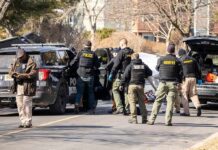
From the first 911 calls, responders treated the incident as a high-risk event. Baltimore County Fire officials requested a first-alarm mass-casualty response, a standard move when a bus and multiple vehicles are involved and the number of patients is uncertain. Initial media reports varied on the total number of people transported—early counts mentioned up to four hospitalizations—but later, consistent figures emerged from county fire and police updates.
According to those official summaries, three people were ultimately taken to local hospitals with minor injuries: the bus driver, one child aboard the bus, and an adult who was at the scene but not on the bus. Two additional children from the bus and eight other individuals in the area were evaluated by emergency medical services and declined transport, leaving at least eleven people directly affected but only three requiring hospital care. That pattern—large numbers assessed, a smaller number transported—is typical in bus crashes; responders err on the side of caution and evaluate anyone who may have been exposed to impact or debris.
Conditions at the Scene and Witness Accounts
Witnesses described a violent, disorienting moment. Local reporting notes that the building shook as the bus hit, merchandise fell from walls, and at least one employee was briefly pinned between the bus bumper and an interior wall before rescuers could reach them. People inside and nearby compared the jolt to an earthquake, a common metaphor when structural vibrations radiate through a small commercial block.
Surveillance footage from businesses at the intersection captured parts of the lead-up but not the critical moment of impact. One video reportedly shows a vehicle on Harford Road and the bus on adjacent Taylor Avenue, but the actual collision is off-frame. That partial record is enough to confirm the presence and movement of the vehicles but not enough to substitute for a full crash reconstruction. Police have therefore relied on physical evidence, vehicle positions, and driver and witness statements to establish that the Ford Focus intruded into the bus’s lane, rather than the bus abruptly departing its course on its own.
How Authorities Have Framed the Cause
From the beginning, county officials have been careful to distinguish what is known from what remains under investigation. In a follow-up briefing, Baltimore County Police stated that their working account is that the Ford Focus crossed into oncoming lanes, striking the school bus and a Nissan Altima, and that the bus subsequently collided with the pharmacy. The Baltimore County Fire Department’s public statements have focused on medical outcomes: minor injuries, no entrapment, and rapid stabilization of the scene.
The Maryland School for the Blind, in its own written statement, echoed that restrained framing. The school confirmed that a bus transporting its students was involved in a “traffic accident” on Harford Road, noted that the bus driver and one child from the bus, plus one other adult on location, were transported with minor injuries, and emphasized that two other children and eight individuals at the scene declined further medical treatment. Administrators underscored their gratitude for the prompt response of fire, EMS, law enforcement, and hospital personnel and stated explicitly that the cause of the accident remains under investigation, with no additional details to be released until that process is complete.
Why Injury Reports Shift in the First Hours
Readers looking back at the coverage will notice that early reports disagreed about how many people were hurt and how seriously. One outlet described two adults and two children hospitalized; another mentioned three people transported; still another framed it as “multiple injuries” with early references to a mass casualty incident. For someone following the story in real time, that variability can be disconcerting, but it reflects how information flows in complex incidents.
In the first hour after a crash, dispatchers, medics, and hospital staff are triaging under time pressure. “Injury” can mean anything from a minor bruise to a suspected internal trauma; what matters operationally is whether a patient needs a ride to the hospital, not the eventual ICD code on a medical chart. As assessments firm up and patients either accept or decline transport, numbers are revised downward. Here, the authoritative accounts—Baltimore County Fire updates and the school’s own statement—converge on a small group of transported patients with minor injuries and a larger group assessed and released on scene.
Context: School Buses, Vulnerable Students, and Safety Records
Any school bus crash draws attention; a crash involving students from a school serving blind and visually impaired children draws something more like alarm. Those students typically rely on school-provided transportation to an unusual degree, because standard neighborhood walking routes, bike rides, or parental car pools may not be practical or safe. For families, trust in the bus and in the system that supervises it is non-negotiable.
It is important to separate this Parkville crash from previous, unrelated bus incidents in the Baltimore region. In a widely studied 2016 crash in Baltimore city, investigators with the National Transportation Safety Board (NTSB) found that a different bus driver—working for a different contractor—lost control due to a seizure related to a long-standing medical condition that should have disqualified him from operating a commercial vehicle. That case led NTSB to criticize both the contractor and Baltimore City Public Schools for inadequate driver oversight and highlighted the absence of collision-avoidance technology as a contributing factor.
Nothing in the current Parkville record suggests a similar driver medical issue or systemic contractor failure. The working police narrative attributes the initiating event to a private vehicle veering into the bus’s lane, not to driver incapacitation or mechanical failure. The relevance of the 2016 case here is not causal but contextual: it illustrates why officials now move quickly to communicate about school bus crashes, and why parents and neighbors scrutinize every detail.
Several people were taken to area hospitals after a school bus carrying students from the Maryland School for the Blind crashed into a building in Parkville on Tuesday afternoon, prompting emergency crews to declare a mass casualty incident.
The crash happened shortly after 2:40… pic.twitter.com/aXVYk4gTXI
— The Baltimore Sun (@baltimoresun) July 21, 2026
Local Traffic Design and Perception of Risk
Neighbors interviewed in the aftermath of the crash pointed to a broader pattern on Harford Road: frequent speeding, risky U-turns, and congestion at key intersections. When a dramatic crash occurs at a spot residents already consider dangerous, it tends to confirm their lived experience and intensify calls for change—better enforcement, redesigned intersections, or added traffic-calming measures.
From a safety-analysis standpoint, however, one vivid incident is not enough to prove that road design is inherently flawed. A proper assessment would look at years of collision data on the Harford Road corridor: frequency and types of crashes, vulnerable user involvement, and the specific geometry of intersections like Harford and Taylor or Harford and Lavender. The public narrative, understandably, runs ahead of that analysis, but any policy response—from adding turn restrictions to re-timing signals or redesigning lanes—will rely on the quieter work of transportation engineers and police analysts rather than the emotional arc of a single event.
What Remains Unanswered
While investigators have identified the Ford Focus’s lane intrusion as the initiating event, many details remain either undisclosed or still under review. Publicly available reporting does not yet explain why the Focus crossed the center line—whether driver distraction, impairment, a medical event, mechanical failure, or roadway conditions played the decisive role. Nor does it detail the exact speed of the vehicles, the angle of impact, or the structural assessment of the pharmacy building beyond immediate safety checks.
Those gaps are normal at this stage. A full police crash report typically includes diagrammed vehicle paths, statements from all drivers and key witnesses, and sometimes data from electronic control modules. That documentation, along with any internal review by the bus contractor and school system, will shape decisions about potential citations, civil liability, or internal safety changes. For the families and staff involved, however, the most immediate question has already been answered: the children and adults hurt in the crash were able to leave the scene with minor injuries, and the worst fears that accompany any phrase like “school bus into building” did not materialize.
Sources:
nypost.com, youtube.com, wbaltv.com, foxbaltimore.com, facebook.com